

This is Part Two of a five-part series on pakikiramdam as a four-layer sensing practice. Part One — The Four Layers: An Introduction offers the orienting map for the whole series. Each part can be read on its own, but they deepen in sequence.
A Pink Envelope and a Black Screen
It all boiled down to the pink envelope that I received at the reception of the surgery department.
That pink envelope that to the trained eye means oh, she’s from that department.
That pink envelope that made me come face to face with an experience I had kept buried for so long — an experience I had dreaded since my mother’s prognosis those many years ago.
I held that pink envelope, fighting the tears that were so close to spilling. I knew my voice quivered when the first-line assistant asked what brought me there. I knew because I heard myself blurting it out for the second time to a stranger: I felt a bump on my left breast.
It all happened too fast. One minute I was telling my husband what I had felt — what I had been feeling for the past four days — and then, in what seemed like the next, he was whisking us off to the doctor’s office for the early morning consultation. We could drop by without an appointment.
I finally said it out loud to the doctor — what I had admitted to myself, and then finally to my husband, after keeping quiet for four days. There is a lump. And she felt it too. She signed off a referral letter for a mammogram, and along with it, an echo or a possible biopsy, depending on what was seen.
I didn’t have to wait long for an appointment. There was a slot free that afternoon. It felt like one of those moments where everything falls into place smoothly — only this time, there was that element of apprehension. This time, serendipity should not have made its moves. The doctor should have just said: oh, it is probably a hormone thing. Let’s wait another couple of days. But instead, I went from one wing of the hospital to another, clutching that pink envelope with a lump in my throat, making it difficult to swallow what was happening.
Whoever devised the mammogram is probably a man. Surely no woman in her right mind would create such a torturous machine. But I needed to do what needed to be done.
Immediately after, I was put on my side for the ultrasound. It was there that I was faced with another bitter truth — that black space on the monitor. The black space that the surgeon measured, clicked, and went through over and over again.
A biopsy was made. I felt cheated that I couldn’t share such a difficult moment with my husband. Why can’t partners be allowed in that space?
The assistant offered her hand and I held it. But the pain was not from the needle piercing through my flesh. It was from the thoughts that flowed like a gush of rain, pouring without me willing it. What are they going to find? What is there? And poor mommy — she went through a tougher biopsy. And I should know, because I was there with her on that day.
The hand I wanted holding mine was my husband’s — so that I could have kept my thoughts to just the two of us, to him and the kids, to this moment and this life. But I was robbed of that choice. And so I kept holding the assistant’s hand. Because I just needed something to bring me back to that room, to that moment, to my own body — and away from the room I had stood in years before, watching my mother go through the same thing.
And that was my day.
A pink envelope and a black screen. And the waiting had just begun.
I wrote this 12 years ago when I had my first breast cancer diagnosis. I was thirty-seven years old and I had known for four days, not in the way we usually mean when we say “I knew.” It wasn’t with certainty, nor with the kind of knowing that comes with a diagnosis or a name or a letter from a doctor. But in the way the body knows. This quiet, insistent sensing and knowing before we have words for it, before we are ready to say it out loud.
Four days of my body trying to tell me something. Four days of that knowing sitting in my chest alongside the thing I had not yet named. Four days of the body speaking, and the mind holding its breath.
This is the layer I call Sensing from Within.
And what I know now having lived through that day, and through everything that came after is that the body was not wrong. It was never wrong. It was, in fact, the most truthful thing in the room. Long before the mammogram. Long before the black screen. Long before the word that eventually came.
The body speaks first. Always. The question is whether we are listening.
What Sensing from Within Actually Is
Sensing from Within is the first and most immediate layer of pakikiramdam. It is the practice of turning attention to what the body is already holding even before thoughts, before perceptions, or before the social self has composed itself into whatever the situation requires.
It is not the same as thinking about how we feel. It is prior to that. It is the felt quality of being alive in this body, in this moment - the breath, the jaw, the weight in the chest, the quality of ease or effort in the limbs, the presence or absence of ginhawa.
Ginhawa, the breath, ease, the inner energy and spirit moving freely through the body is the orientation of this entire layer. It is what Sensing from Within is always moving toward or away from. When ginhawa is present, the body is at home in itself. When ginhawa is absent, when the breath is shallow, the chest tight, the energy contracted or flooded, the body is trying to tell us something.
The entry point of this layer is ulirat, Virgilio Enriquez’s concept of awareness of one’s immediate surroundings, the most surface register of consciousness in Filipino psychology. Ulirat is the simple, fundamental noticing: I am here. In this body. In this room. In this moment. Before anything else, before the feelings, before the memories, before the parallel lives that crowd in, there is our ulirat. The bare, present-tense awareness of being alive and located.
From ulirat, the deeper sensing can begin. It is a new way of listening to the signals before they become a crisis.
But for many of us, particularly those shaped by cultures and systems that taught us to override the body, to perform wellness, to be useful before being honest, the path to Sensing from Within has been deliberately obstructed. We have been taught to distrust what the body knows. To wait for external confirmation. To keep quiet. To resist what the body is telling us.
The practice of Sensing from Within is, in large part, the practice of unlearning that. it is a reclamation, a liberation process of restoring the body’s authority as a site of knowing.
How the Body Speaks to Itself
Western medicine has long operated with a particular assumption: that the body is primarily a mechanical system, organized hierarchically, with the brain giving instructions and the body obeying. The brain decides. The body executes.
What neuroscience, somatic research, and indigenous wisdom traditions have been converging on, for different reasons, through different methods, across very different histories, is that this picture is radically incomplete. The body is not a passive receiver of instructions from above. It is an active, intelligent, multi-directional communication network. It speaks to itself constantly through the nervous system, through the fascial web, through the lymphatic system, through the microbiome, through the breath. And what it says matters, not just for physical health, but for how we sense, feel, relate, and know.
Here are the three primary interior communication systems through which Sensing from Within becomes possible.
The Nervous System: The Body’s Primary Messenger
The nervous system is the most familiar of the three and still the most underestimated in its full complexity.
Most people understand the nervous system as the brain sending signals to the body. But the communication is overwhelmingly bidirectional and in fact, the majority of signals travel from the body to the brain, not the other way around. The vagus nerve, the primary channel of this bottom-up communication, carries approximately 80% of its signals upward, from the body’s organs, tissues, and viscera to the brain. The body is not waiting for instructions. It is reporting, constantly, on what it is experiencing.
This is the biological basis of interoception, the body’s capacity to sense its own interior states. The heartbeat, the breath, the gut, the throat, the quality of tension or ease in the muscles and organs, all of this is being reported upward through the vagus nerve and other interoceptive pathways, feeding the brain’s continuous construction of what is happening and what it means.
And beneath conscious interoception is neuroception. This is Stephen Porges’ term for the nervous system’s subconscious, automatic scanning of the environment for cues of safety or threat. Neuroception is not perception. It happens below the threshold of awareness entirely. The body has already decided whether the room is safe, whether the person in front of us is trustworthy, whether to open or to brace long before any conscious thought has formed.
In that hospital corridor, holding that pink envelope, my nervous system was doing both simultaneously. It was receiving the signals from my own body, the tightness in my chest, the quiver in my voice, the lump in my throat and it was scanning the environment,the quality of the fluorescent light, the particular silence of the radiology waiting room, the way the technician did not quite meet my eyes. All of it being processed, all of it shaping my experience, none of it yet fully conscious.
The nervous system also holds memory not only in the brain but in the body itself. Somatic memory. Body-based knowing that does not require language or narrative. This is why my mother’s biopsy was suddenly present in the room with me during my own. It was not a thought I chose to think. It was a body memory that arrived without invitation because the nervous system recognized the situation, the sensory field, the quality of the moment, and retrieved what it had stored from the last time something like this happened.
This is intergenerational sensing. The body carrying what the experiences transmitted through our families and communities- not metaphorically, but biologically. We will return to this in depth in Part Four.
Fascia: The Body’s Organ of Communication
Until recently, fascia was understood primarily as packaging, the connective tissue that wraps around muscles, organs, and bones, holding the body’s structure together. Useful, but passive. Background.
What fascial researcher Robert Schleip and others have been demonstrating through rigorous laboratory science is that fascia is anything but passive. It is, in Schleip’s words, an organ of communication and it may be the richest sensory structure in the entire body.
Fascia contains approximately 250 million nerve endings compared to 200 million in the skin and 120 million in the visual system. Around 80% of the nerves in the fascia terminate as free nerve endings, transmitting signals that contribute to both proprioceptive (body position and spatial awareness) and interoceptive (interior state sensing) functions. These signals are slower and more nuanced, enriching our awareness of body position, movement, and internal states.
The tissue that runs through the entire body without interruption and that connects every structure to every other structure in one continuous, three-dimensional web is also one of the body’s primary sensing organs. It is registering what is happening throughout the body at a level of detail and nuance that the muscular system alone cannot provide.
The fascial web is intertwined with the nervous system, with mechanoreceptors (specialized sensors that detect pressure, tension, and movement) providing the environment for both proprioception and interoception. Fascia has been described as simultaneously electromagnetic and faster to react than the nervous system creating piezoelectric effects (tiny electrical charges generated by mechanical pressure) throughout the body’s structure in response to mechanical stress.
What this means for healing-centered work is profound. The fascial tissue changes its quality in response to stress, trauma, and chronic protective patterns, becoming dense, restricted, and less able to transmit sensation freely. Many somatic practitioners and researchers observe that this tissue restriction is where the body’s experience of unprocessed emotion is most tangibly held, in the places where we have braced, contracted, or armored ourselves over time. The peer-reviewed science on the precise mechanisms of emotional holding in fascia is still emerging, but what somatic practitioners consistently observe in bodywork with people healing from trauma aligns with what the research is beginning to confirm: the body remembers in its tissue, not only in its neurons.
This is what hapit (constriction — the body tightening against what is coming) feels like from the inside. Hapit is not only a nervous system event. It is a fascial event. The web is pulling inward, tightening, organizing itself around protection.
And this is why movement, touch, breathwork, and somatic practice matter so profoundly in healing. The fascia of the skin and muscles has a lot to say to the brain about the mind-body connection more than the muscles themselves. The fascia is on the front line for handling forces, and the various sensory nerves are its messengers to the brain. When we move gently, when we breathe into areas of tightness, when we receive compassionate touch, we are speaking directly to the fascial web, inviting it to soften, to release, to allow the body’s interior communication to flow more freely again.
This is gaan (lightness and ease in the body, the quality of being unguarded and unobstructed) not just as a nervous system state but as a fascial state. The web releasing. The body becoming permeable to itself again.
The Lymphatic System: The Body’s Slow River
The lymphatic system is the least visible and most underappreciated of the three and yet it is one of the most important for understanding how the body holds and processes experience over time.
The lymphatic system is often described as the body’s drainage system, a network of vessels, nodes, and fluid that runs alongside the circulatory system throughout the entire body. Its primary functions are fluid balance, waste removal, and immune response. The lymph fluid carries away the cellular debris, the pathogens, the inflammatory markers that accumulate in tissues — filtering them through lymph nodes, which act as the body’s intelligence checkpoints, determining what is safe and what needs to be neutralized.
Recent research has uncovered a direct cellular interaction between the nervous and immune systems. Pain-sensing neurons surround lymph nodes can modulate the activity of these small organs, which are key parts of the immune system. This direct coupling between the nervous system and the lymphatic system means that what the nervous system is experiencing as threat, safety, chronic stress, or ease directly affects how the lymphatic system functions. When we experience chronic stress, cortisol (the stress hormone) is released, and its acidic nature can cause a breakdown of lymphoid tissue and impede lymphatic flow. Chronic exposure to cortisol can suppress immune function, reducing the circulation of protective antibodies and thus increasing susceptibility to infection and disease.
In other words, chronic protecting, the nervous system locked in threat response, does not only affect mood, cognition, and behavior. It directly impairs the body’s ability to clear, restore, and protect itself at the cellular level.
Some healing traditions and integrative practitioners have long observed that the lymphatic system carries not only physical debris but emotional residue, the unprocessed fears and griefs that accumulate when the nervous system has been in chronic protection. This perspective is not yet fully mapped by mainstream science, but it is a compelling area of emerging inquiry and one that aligns with what somatic practitioners consistently observe in people healing from chronic stress and trauma. What is scientifically confirmed is the direct coupling between the nervous system and the lymphatic system and the downstream effects of chronic cortisol on lymphatic flow and immune function. The body’s capacity to clear and restore is not separate from its emotional and relational life. They are the same system.
This is what pagod and pagal (soul-tiredness and depletion - the specific heaviness of a body that has been carrying too much for too long) feel like from the inside. This is not just tiredness but the heaviness of a body whose lymphatic system has been carrying too much for too long. The sluggishness, the lethargy, and the sense of being waterlogged with something that has not been able to move through.
Here is the critical thing about the lymphatic system that makes it unlike every other major system in the body: it has no pump of its own. The heart pumps blood. But lymph moves only through movement, through the contraction of muscles, the rhythm of breath, and the gentle pressure of motion. When we are still, lymph stagnates. When we move, when we breathe deeply, when we walk, when we sway or stretch or shake, lymph begins to flow.
This is why movement is not optional in healing work. It is not about exercise or productivity or achieving physical fitness. It is about restoring the body’s capacity to clear what has accumulated and to move through what has been held. Every time we breathe into the belly, every time we walk in the open air, every time we allow the body to move in ways that feel good rather than forced, we are supporting the lymphatic river to flow again.
In Filipino psychology, this connects to ginhawa at its most literal - the full breath that allows the body’s interior systems to circulate freely. Ginhawa is not just ease. It is the biological condition that makes clearing, repair, and restoration possible.
The Sensing Capacities in Depth
In Beneath the Iceberg, I wrote about the eight senses our nervous system draws on to assess the world around us - the five classic senses alongside vestibular (balance and spatial orientation), proprioception (body position in space), and interoception (interior body states). Here we go deeper into all of these, and add two further layers, nociception (sensing of pain and potential harm) and neuroception (subconscious safety scanning), that are essential for understanding how pakikiramdam works from within.
These are not separate instruments playing in isolation. They are an integrated orchestra with each sensing a different dimension of what is happening inside and around us, all feeding the nervous system’s continuous construction of what is present and what it means.
Neuroception: The Pre-Perceptual Ground
Neuroception is the nervous system’s continuous, subconscious scanning for cues of safety or threat happening entirely below the threshold of conscious awareness. It was named by Stephen Porges through his development of Polyvagal Theory, and it represents a paradigm shift in how we understand nervous system functioning.
Before neuroception was named, the nervous system was understood as responding to what we consciously perceived. Neuroception revealed that the response comes first, the body has already oriented, already braced or opened, already begun to organize a protective or connective response, before we have formed any conscious perception at all.
This is why we cannot simply decide to feel safe. Neuroception is not under voluntary control. It is shaped by the accumulated history of what the nervous system has learned from our own lived experience, from the experiences transmitted through our families and communities, from the cultural and ancestral patterns held in the body. A person who grew up in an environment of chronic threat will have a nervous system that has learned to read ambiguous signals as dangerous. This isn’t because they are irrational or oversensitive, it’s because their nervous system is being loyal to what it learned, to what it deemed as comfortable.
Healing, in this framework, is in large part the slow, patient work of helping the nervous system update its neuroceptive patterns through repeated experiences of genuine safety. It can be through relationships that consistently offer co-regulation (the calming of one nervous system through contact with another regulated one) and practices that help the body learn, over time, that the present moment is not the same as the past.
This is the biological ground of pakikiramdam and it is also the biological ground of kaginhawaan — the resourced state, the condition of ease, full breath, and genuine responsiveness. Kaginhawaan is not a mental achievement. It is a neuroceptive one. The nervous system has registered enough safety to open.
Interoception: The Interior Report
Interoception is the body’s capacity to sense its own interior states, the felt quality of the heartbeat, the breath, the gut, the chest, the throat. It is the interior reporting system through which the body accounts for its own condition.
Contemporary neuroscience has come to understand interoception as foundational to emotional experience itself. We do not first have a thought and then feel an emotion. We first have a body sensation and then the brain interprets that sensation within a context, producing what we experience as an emotion. Interoception is prior to emotion. It is the raw felt material from which emotional experience is constructed.
This means that when interoception is disrupted, when the body’s interior reporting is suppressed, numbed, or overridden, our emotional life becomes harder to navigate. In this situation, their somatic ground has been cut off. People describe feeling disconnected from themselves, unable to identify what they are feeling, knowing intellectually that something is wrong but unable to locate it in the body.
For many people shaped by colonial cultures, extractive systems, or family environments where feelings were not safe, interoception has been systematically suppressed. The body learned to go quiet, to not report what it was experiencing, or to perform wellness rather than sense it.
The Filipino felt markers of interoception when resourcing are:
sigla (vitality and aliveness, the felt sense of having something to bring)
gaan (lightness and ease),
gana (appetite for life, the yes of the whole self),
ligaya (quiet wholehearted joy),
ginhawa (ease and full breath)
These are not just poetic descriptions. They are interoceptive states, precise body-based experiences that can be sensed, recognized, and cultivated. Having words for them makes them more accessible. The vocabulary of Filipino psychology, in this sense, is itself a healing tool as it expands the range of what the body can be known to hold.
Proprioception: Knowing Where We Are
Proprioception is the body’s sense of itself in space. This is an inner knowing of where we are in relation to gravity, how our limbs are positioned, and whether we are balanced or off-balance, grounded or floating.
It operates through mechanoreceptors (pressure-sensitive sensors) in the joints, muscles, and connective tissue including, as we now know, the fascial web that continuously report the body’s spatial position to the brain. Proprioception is what allows us to walk in the dark, to reach for a glass without looking, to know intuitively where our hands are without having to check.
In healing-centered work, proprioception carries particular significance because it is often the first capacity to become disrupted under threat. When the nervous system is protecting through rigidity, braced, locked, unreachable, people describe losing the felt sense of their body in space. Other report feeling unmoored, floating above themselves, or unable to find their feet on the ground. Dissociation, in its somatic dimension, is in part a proprioceptive disruption, the body’s location becoming uncertain or inaccessible.
When the nervous system is protecting through porosity, dissolved, merged, carrying everyone, proprioception is disrupted differently. The body’s boundaries become unclear. There is no felt sense of where I end and the field begins. Grounding practices here serve a slightly different purpose. It is not just locating the body in space but restoring the felt sense of the body as a distinct, boundaried entity with its own interior.
This is why grounding practices, the deliberate sensing of the feet on the floor, the weight of the body in the chair, the relationship between the spine and gravity are so foundational in somatic healing work. They are proprioceptive practices. They send the nervous system a simple, powerful signal: I am here. My body has a location. The ground is trustworthy.
This is where ulirat, Enriquez’s concept of awareness of one’s immediate surroundings, the bare noticing of being present in this body, in this space meets proprioception. Ulirat is the Filipino psychological parallel of what proprioception offers somatically, the grounded awareness of being here, now, and located.
Exteroception: The Five Senses Reading the World
Exteroception, the five classic senses, is how we take in information from the environment. Sight, sound, smell, taste, touch. It is the most familiar of the sensing capacities, the one we are most culturally trained to notice and trust.
What is less recognized is how profoundly exteroception is shaped by the nervous system’s state. Neuroception and exteroception are constantly in dialogue with the five senses feeding the subconscious safety scanning, and the results of that scanning shaping what the five senses can even register.
In rigid protecting, exteroception narrows dramatically. The visual field narrows to a tunnel. Sound becomes either hyper-acute (scanning for threat) or muffled (shutting down). The world contracts to what is immediately relevant to survival.
In porous protecting, exteroception floods. Everything comes in at once with no filter, every sound, every visual stimulus, every energetic quality of the room are overwhelming the system’s capacity to organize and respond.
In resourcing, exteroception opens into its full richness. Beauty becomes accessible. Subtlety becomes perceptible. The world can be taken in again, with curiosity rather than vigilance.
This is, in part, what gana (appetite for life, genuine willingness to engage) feels like - the senses are open, the world is interesting, and the body wants to meet what is here.
Nociception: The Body’s Pain Intelligence
Nociception is the body’s sensing of actual or potential harm.These are the signals that communicate that something is wrong, something needs attention, something in the body’s integrity is at risk.
In the biopsy room, nociception was present - the needle, the tissue, the physical pain. But what I described in that moment was something more complex: the pain was not primarily from the needle piercing through my flesh. It was from the thoughts that flowed like a gush of rain, the memories that arrived without being invited, and the ancestral body memory of my mother’s biopsy flooding the present moment.
This is an important teaching about nociception: physical pain and emotional pain travel through overlapping neural pathways. The pain of loss, of grief, of isolation, of shame, these are not metaphorical pains. They register in the body through similar mechanisms to physical pain. The distinction between physical and emotional suffering, at the neural level, is far less clean than we have been taught.
In rigid protecting, nociception is often disrupted in one of two directions — either the body becomes hypersensitized (pain signals amplified, the system on high alert) or numbing occurs (pain signals suppressed). In resourcing, nociception can do its actual and necessary work. It provides information without hijacking, and signaling without flooding. Pain becomes information rather than emergency.
The Vestibular System: Balance, Ground, and Trust
The vestibular system which is housed in the inner ear governs our sense of balance, movement, and spatial orientation. It tells us whether we are moving or still, upright or tilted, accelerating or decelerating.
What is less commonly understood is the profound connection between vestibular functioning and emotional regulation. The vestibular system is directly connected to the autonomic nervous system, the same system that governs the stress response. When the vestibular system is dysregulated, under chronic stress, trauma, prolonged illness, or overwhelm, the felt experience is of a ground that cannot be trusted. Unsteadiness. Disorientation. A sense that the floor might give way.
Conversely, vestibular input is one of the most powerful and most ancient forms of nervous system regulation available to us. Rocking. Swaying. Slow rhythmic movement. Gentle oscillation. These are the movements that mothers have used to settle distressed infants across every culture and every era of human history. Bayanihan (the Filipino practice of the community coming together to carry what one person cannot carry alone) contains vestibular wisdom, the movement of a community working together in rhythm speaks to the vestibular system. The body is being told: you are held. You will not fall. We are moving together.
This is the somatic ground of gaan, that quality of lightness and ease that becomes possible when the body trusts the ground beneath it. The vestibular system has settled. The body can be light because it knows it will not fall.
These Capacities as an Integrated Orchestra
What matters most is not any single sensing capacity but how they work together , feeding each other, cross-referencing each other, building a composite picture of what is happening inside and outside, and what it means for safety, connection, meaning, and action.
These sensing systems come together in awareness to form our sense of self and help us respond to our environment. Neuroception conducts. The others report. And together they constitute what the body actually knows, before the mind has formed a single word about any of it.
This is what pakikiramdam draws on. Not one channel but the whole orchestra. This goes beyond conscious analysis, rather the integrated sensing of a body that has been paying attention to itself, to others, to the field, to what is present and what is absent, and to what is said and what is not said.
The table below shows how each sensing capacity shifts across the three processes:
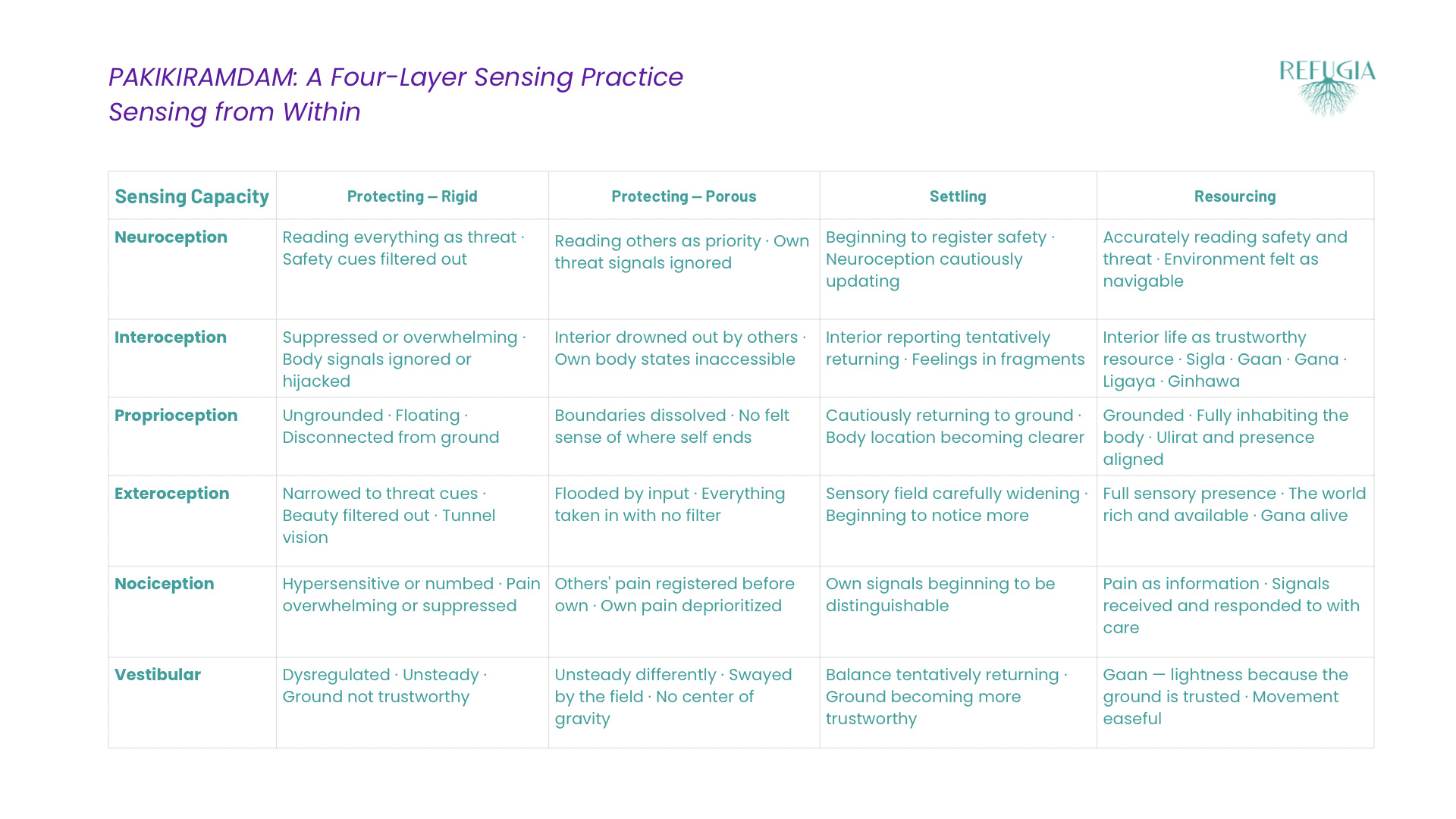
Sensing from Within Across the Three Processes
Now we can map the full vocabulary of this layer — what the body holds in protecting, settling, and resourcing, through all of its sensing capacities together.
Protecting — Rigid The body locked, braced, unreachable. The membrane has become a wall.
The nervous system has read the environment as threatening and organized the body into hardened protection. The fascial web has tightened, hapit (constriction, bracing), the body tightening against what is coming. The lymph is sluggish under the cortisol load of chronic stress. The vestibular system is dysregulated and the ground does not feel trustworthy.
Filipino felt markers:
Hapit (constriction, bracing)
Pagod (soul-tiredness, beyond physical fatigue)
Pagal (depleted to the bottom)
Kapos sa hininga (running out of breath, overwhelm as a body state)
Walang gana (flatness, the complete absence of appetite for life)
Lakas ng takot (strength organized entirely by fear)
Ulirat (consciousness) narrowed to threat scanning only
English felt words: Frozen · Braced · Locked · Numb · Heavy · Hollow · Rigid · Shut down · Collapsed inward · Unreachable · Dissociated · Nowhere to land
Yearnings in this process: Safety · Relief · Rest · To stop · Breath · Enoughness · Just this moment to be survivable
Protecting — Porous The body without membrane, flooded, carrying everyone. The membrane has dissolved.
The nervous system has dissolved the membrane between self and field, taking everything in, carrying everyone’s state, losing track of its own interior. The fascia has lost its tonal integrity. The lymph is overloaded and processing not just its own debris but the accumulated weight of everyone else’s experience.
Filipino felt markers:
Walang sariling loob (literally “having no interior self of one’s own” — no interior ground, the self dissolved into the field)
Gana directed entirely outward — appetite only for others, none remaining for self
Ulirat overwhelmed by external cues
English felt words: Flooded · Merged · No membrane · Hypervigilant to others · Running on empty · Invisible as a self · No felt sense of where I end and you begin · Numb to own needs while acutely attuned to others · Present for everyone except oneself
Yearnings in this process: To find the edges of oneself · Rest that is genuinely for me · Permission to not carry · To feel my own breath separate from yours · Enough interior ground to stand on · To matter to myself not just to others
Settling The body cautiously finding its way back. The membrane beginning to form.
The nervous system is beginning to register safety not fully, not without reservation, but enough. The fascial web is beginning to soften at its edges. The lymph is beginning to move. The vestibular system is finding its tentative footing.
From rigid protecting, settling looks like cautious opening, the wall developing small windows, the bracing softening at its edges, and the body beginning to breathe a little more freely.
From porous protecting, settling looks like cautious boundarying, the dissolved self beginning to find its edges, the body’s membrane beginning to form, and the interior becoming distinguishable from the field again.
Filipino felt markers:
Naguguluhan (confused but searching, not shut down)
Nangangapa (feeling one’s way cautiously in the body)
Patumpik-tumpik (stop-start, the body trying to regulate but not yet smooth — the fist that has opened slightly but not yet released)
Ulirat widening
English felt words: Tentative · Wobbly · Cautious · Flickering · Partly settled · Partly still braced or dissolved · Watchful but curious · Warming · Something loosening · Tired but willing · Present but fragile · Cautiously softening · Breath stuttering back but still shallow · Beginning to notice more than threat
Yearnings in this process: Ginhawa beginning, just enough breath · Pacing · Gentle warmth · Permission to be partly · Not to be rushed · Rest that doesn’t require explanation · Enough safety to feel the body again
Resourcing The body at home, breathing fully, available. The membrane responsive and discerning.
The nervous system has registered enough safety to open fully. The fascial web is supple and responsive. The lymph is flowing, clearing, restoring. The vestibular system is settled and the ground is trustworthy, the body can be light.
Filipino felt markers:
Sigla (vitality and aliveness, the felt sense of having something to bring)
Gaan (lightness, ease, unguardedness in the body)
Gana (appetite for life, the yes of the whole self)
Ligaya (quiet wholehearted joy, the body knowing it is well)
Ginhawa (ease, full breath, spaciousness as a lived body state)
Ulirat open — full sensory presence
Bahala na as the full conscious exhale — the body releasing from trust not depletion
English felt words: Energized · Vital · Light · Easeful · Alive · Resourced · Rested · Restored · Grounded · Spacious · Unguarded · Present · Whole · Breathing fully · At home in the body · Fully here · Self-fullness
Yearnings in this process: Ginhawa, ease and full breath · Sigla, to feel vital and capable · Pahinga (rest that truly restores, the body fully letting go) · Nourishment · Vitality · Movement that feels like aliveness not urgency · Care of the body as sacred · Ulirat — full presence to this moment and this place
What Sensing from Within Asks of Us
To develop the capacity to sense from within, to practice this first layer of pakikiramdam requires three things above all.
Slowing down. The body cannot be heard at urgency’s pace. Urgency is itself a neuroceptive state — the nervous system on alert, racing toward resolution, unable to tolerate the not-yet-knowing that genuine sensing requires. There is a phrase I return to often in this work: we can only go as fast as the slowest part of us feels safe to go. To sense from within is to practice the deliberate deceleration that creates the conditions for the body’s intelligence to become audible.
Curiosity not judgment. The body does not lie but it can be silenced. When we meet the body’s signals with criticism, why am I feeling this, I shouldn’t feel this, this is inconvenient, we teach the interior to go quiet again. The practice is to bring genuine curiosity to what the body holds. Not fixing. Not analyzing. Simply asking: what is here? What is my body trying to tell me? And then waiting, genuinely waiting, for the answer.
The vocabulary to meet what we find. Language shapes experience. When we have words for sigla (vitality), gaan(ease), gana (appetite), hapit (constriction), kapos sa hininga (breathless overwhelm), and walang sariling loob (no interior ground of one’s own), when we have a felt vocabulary that includes both the resourcing states and the protecting ones without pathologizing either, we create the conditions for the body to be known at greater precision and greater depth. The body can be met more fully when we have words that are equal to what it holds. This is one of the gifts that Filipino psychology offers the healing world, a genuine expansion of what it is possible to sense, articulate, and honor in human experience.
Practices for Sensing from Within
These are not techniques to master or protocols to follow in sequence. They are invitations and ways of returning to the body’s intelligence when the connection has become thin or difficult. Begin with whatever feels most accessible. Even one breath, deliberately taken, is a practice.
Ulirat — arriving here first Before anything else, ulirat (the simple noticing of being present in this body, in this space, in this moment). Try this: pause whatever you are doing. Feel the weight of your body where it meets the surface beneath you — chair, floor, ground. Notice the temperature of the air on your skin. Hear whatever sounds are present without trying to identify or analyze them. This is ulirat. You are here. Begin here.
Ginhawa — returning to the breath Ginhawa (ease, full breath, the inner energy moving freely) is both the practice and the destination. The full breath and not a performed breath, not a correct breath, but whatever breath the body actually wants to take is the most direct path back to Sensing from Within. When you notice you have lost contact with your interior, return to the breath first. Place a hand on your belly or your chest. Feel the rise and fall. Notice whether the breath is shallow or deep, whether it catches or flows. Follow what the body wants, not what you think you should do.
Body scanning — moving attention downward
Begin at the top of the head and move slowly downward — scalp, face, jaw, throat, shoulders, chest, belly, lower back, hips, legs, feet. At each place, simply ask: what is here? Not what should be here, not what you want to find but what is actually present. Tension. Ease. Numbness. Warmth. Pulsing. Heaviness. Notice without judgment. The body is reporting. Your task is simply to receive the report.
Grounding through proprioception
When you have lost the felt sense of your body in space, when you feel unmoored, floating, or dissociated, proprioceptive grounding can help the body relocate itself. Press your feet firmly into the floor. Feel the ground pushing back. If sitting, feel the chair beneath you, the solidity of it. You can also try pressing your palms together firmly, or placing both hands on a solid surface and pressing down. The body is finding its edges again. This is settling from within.
Movement for lymphatic flow
Because the lymphatic system has no pump of its own, gentle movement is one of the most direct ways to support the body’s capacity to clear and restore. Walking, even a short walk in open air, activates the lymphatic system through the natural pumping action of the muscles. Gentle bouncing on the heels, slow swinging of the arms, or simply rolling the shoulders and neck can begin to move lymph that has become stagnant. Deep belly breathing is also profoundly lymphatic, the diaphragm’s movement creates pressure changes that directly support lymph flow. Ginhawa, again, as both practice and medicine.
Vestibular settling — the ancient practice of rhythm
When the nervous system is dysregulated and the ground feels untrustworthy, rhythmic movement is one of the most ancient and reliable forms of settling. Rocking gently forward and backward. Swaying side to side. Slow walking with attention to the rhythm of the steps. Humming which combines vestibular vibration with vagal tone (the activation of the vagus nerve, which supports calm and connection). These are the movements communities have used across cultures and centuries to settle distress. The vestibular system is being spoken to directly: you are held. The ground is trustworthy. We are moving together.
Working with the fascial web
Slow, sustained stretching held for longer than feels immediately comfortable, then released speaks directly to the fascial tissue. The fascia responds to slow sustained input rather than quick force. When you hold a stretch and breathe into it, you are inviting the fascia to soften, to release some of what it has been holding. Be gentle. Move slowly. The tissue that has been holding for a long time does not release all at once, and it should not be forced to.
Naming what you find — the vocabulary as practice
Finally, and perhaps most importantly, the practice of naming what the body is holding. Not analyzing, not interpreting, not immediately trying to change what is there. Simply naming. I notice tightness here. I notice warmth here. I notice something that feels like hapit - bracing, constriction. I notice something that feels like ginhawa beginning a loosening of breath, the beginnings of ease. The Filipino felt markers we have explored in this article are not just descriptive vocabulary. They are a practice tool. When we name sigla(vitality), we begin to recognize it. When we name walang gana (the absence of appetite for life), we honor what is actually present rather than overriding it. The vocabulary is an act of witnessing the body’s interior life.
Pagmumuni-muni — Deep Reflection
Before you begin, find a comfortable position. Place a hand somewhere on your body where you feel life most clearly. Take one slow breath, not a performed breath, but whatever breath actually wants to come. Ask yourself gently: what is my body holding right now?
Let that question accompany you as you move through these reflections.
On the body’s knowing
When have you known something in your body before you were ready to say it out loud? What was that like?
How long did you hold it before you named it? What made it possible to finally name it?
Looking back, was your body right?
On the three interior systems
Where in your body do you most notice the effects of chronic stress — in the nervous system (anxiety, shutdown, hypervigilance), in the fascial tissue (tightness, restriction, holding), or in the lymphatic system (heaviness, sluggishness, depletion)?
When you move your body — walk, stretch, breathe deeply, sway — what shifts? Where do you feel it first?
What forms of movement most reliably help your body’s interior communication to flow more freely?
On the sensing capacities
Which of the sensing capacities feels most alive and accessible to you right now?
Which feels most shut down or disrupted?
What conditions help your interoception, your interior reporting, to work well? What conditions undermine it?
On the three processes
As you sit with this article, which process does your body feel most engaged in right now — protecting, settling, or resourcing?
From rigid protecting: what is the first sign in your body that you are beginning to settle?
From porous protecting: what is the first sign in your body that your membrane is beginning to return?
When you are resourcing, what does sigla (vitality and aliveness) feel like for you? What does ginhawa (full breath and ease) feel like?
On ginhawa
When did you last experience ginhawa that full breath, that ease, that spaciousness in the body?
What were the conditions that made it possible?
What is one small thing you could do today to move toward ginhawa — not as a destination, but as a direction?
These questions are not meant to be answered all at once. Some may want a day. Some may want a week. Some may surface something that wants to be held for much longer. Let them work in you at the pace they need.
Dear readers,
I wrote the opening of this article — the pink envelope, the black screen, many years before I had the language to fully understand what I was describing.
What I know now is that my body was practicing pakikiramdam the entire time. In the four days of keeping quiet before I told my husband. In the quiver in my voice when I said it out loud for the second time. In the way the assistant’s hand brought me back to my own body when my mother’s memory tried to pull me into hers.
The body knew. It always knows. The question is whether we have the conditions, the safety, the slowness, the vocabulary to listen.
Sensing from Within is not a technique. It is the ongoing practice of returning to the body, to the breath, to the interior life that has been sensing all along, waiting for us to catch up.
Our work is to help create those signs. In ourselves, in our relationships, in the communities and organizations we are part of. Because a body that can sense itself can sense the field. A body that can sense the field can sense the depth. A body that can sense the depth can sense what wants to emerge.
Ginhawa first. Everything else follows.
I am curious what this article is bringing up for you. What did you notice in the pagmumuni-muni? What did your body tell you that your mind had not yet acknowledged? Share in the comments — your experience helps build this collective vocabulary of sensing.
In Part One, we introduced the four layers and the three processes. In Part Three, we will move into Sensing the Between - the relational field, the quality of the space between us, interpersonal neurobiology, ancestral and communal histories in the field between people, and the full depth of the Kapwa taxonomy lived and felt.
Hiraya manawari,
Lana