
SENSING THE DEPTH BEGINS WITH UNDERSTANDING THE SELF
This is Part 5 of Pakikiramdam: A Four Layer Sensing Practice

This is Part Five of (what I initially thought would be 5 parts :D) a seven-part series on PAKIKIRAMDAM as a four-layer sensing practice. Part One — The Four Layers: An Introduction offers the orienting map. Part Two — Sensing from Within explored the body as the first site of knowing.Part Three - Sensing the Between explored the dynamics of the relational field. Part Four - SENSING THE FIELD BETWEEN US: The Four Dimensions of Relational Field Quality offers a more nuanced way of reading the field. Each part can be read on its own, but they deepen in sequence.
I was scrolling on LinkedIn recently when a post moved something in me. I was fascinated by the graphics and the ideas shared in the post, yet there was something there that I was sensing, a particular weight to the words that I was reacting to, especially this line: “Your fear system was built for a world that no longer exists.”
This is a message that I often share when giving an introduction to Neurodiversity trainings. I find this valuable and true, as far as neuroscience goes, AND I do think it doesn’t hold the fuller picture.
As I sat with the words, I kept thinking of this question the post itself never asked: why is chronic threat activation so widespread in the first place that people are in constant fear/survival/protective response?
This is what I replied to the post:
Your fear system was built for a world that no longer exists is true for neuroscience, but it makes the dysregulation look like an individual, ahistorical, universal-human problem (everyone’s amygdala works this way) rather than asking why some nervous systems are working overtime while others aren’t. It individualizes something that’s collective, epigenetic/intergenerational, and cultural.
What I am missing in the conversations around nervous systems is approaching it from “collective nervous systems”. The nervous system doesn’t get chronically activated by accident; it gets chronically activated by chronic conditions.
This spurred me to go back to the rabbit hole that I was immersed in on expanding the notion of the self; in Filipino, we say “loób”, and how this expanded perspective of the loób and kapwa impacts the field.
EXPLORING THE DEPTH MEANS EXPLORING THE LOÓB
Loób, literally translated in English as “inside,” was never a closed system.
This is the sentence I kept arriving at, the same one hiding underneath everything I’d already written about ecosystems of selves, about nervous systems formed by conditions rather than accidents. Loób existed within a precolonial, animistic cosmology, long before the Spanish arrived. It wasn’t a private inner chamber. It was a vital, mystical force, connected to Bathala, the anito, and ancestors who were understood to be still present and around us.
This wasn’t confined to Tagalog either. Cebuano and other Visayan languages call it buot. Ilokano calls it nakem. Kapampangan calls it lub. These aren’t separate translations of the same idea. They’re cognates, sharing a deeply embedded root that predates the archipelago, from before it was called “the Philippines.”
Precolonial cosmology of loób held a soul duality. Ginhawa was the breath and awareness that stayed with the living body. Kaluluwa was the soul that could travel, in dreams, in illness, and in the space between what a person knows and what they sense. These were held together as the vital forces of one’s loób.
In precolonial times, there were also people whose role was to sense across that boundary between the living and the spirit world, babaylan in Visayan communities, katalonan in Tagalog ones. This is worth naming directly as pakikiramdam, the sensing practice that I have been building on in this series, which I’ll return to later in this piece, is not something I’m inventing. It has real precedent in this precolonial, communal role.
When Spanish colonization arrived, loób didn’t stay untouched. The Doctrina Christiana, the first book printed in the Philippines in 1593, is the earliest textual evidence we have of loób being used to translate Catholic doctrine into Tagalog. Loób absorbed centuries of imported moral vocabulary, and it survived underneath that layering, thanks to Filipino psychologists who made us remember.
This is why I don’t think of loob as a pure artifact I’m simply reclaiming. I think of it as something that survived, and this work is my contribution in that field of remembering and re-membering.
Loob from different lenses in Filipino Psychology
A. LOOB ACROSS THE ARCHIPELAGO - Leonardo Mercado
Leonardo Mercado mapped loób across the Philippines’ major languages, showing it wasn’t confined to Tagalog. Buot holds the same meaning across Cebuano, Hiligaynon, and Bikol (most of the central and southern islands). Nakem is the Ilokano term, in the north. Lub is the closest Kapampangan cognate. Even in Mindanao, among the Maranao, the counterpart is amanat. These aren’t loose translations of each other. They’re linguistic siblings, joined using shared ancestry rather than borrowed meaning.
This matters for how I understand loob’s history. It isn’t a Tagalog concept other regions later adopted. It’s one regional expression of something that predates any single ethnolinguistic group, carried in the Austronesian language family itself, arriving independently, island by island, long before “the Philippines” existed as a name for any of them.
Mercado also gave loób’s inner world its structure through three paired dyads:
malay at isip,
dama at bait,
ugali at kalooban.
What I notice in this structure is a pattern: each pair holds a raw faculty alongside its cultivated counterpart. Malay, bare consciousness, paired with isip, formed thought or awareness, ripening into understanding. Dama, raw feeling, paired with bait, common sense and moral discernment. This is feeling ripening into wisdom. Ugali, habitual disposition, paired with kalooban, will, inclination, ripening into deliberate choice. Loób, in this structure, isn’t static content. It’s three continuous movements happening at once, each being a small maturation.
Mercado described this inner world through three concentric circles too: body, soul, and spirit, moving from outermost to innermost. But he was clear these weren’t separate compartments. The Filipino mind, in his account, never separated thinking from feeling from willing from ethical judgment. One circle, moving as one.
B. LOOB AND LABAS - Zeus Salazar
Zeus Salazar (he was also my history teacher in university!) named something I return to constantly: loób can only be known through its galaw, its movement, expressed in labas. What is internal has to find external expression to be known at all.
Zeus Salazar developed the loób-labas dialectic, the understanding that loób and labas are not simply inside and outside but in constant dynamic relationship with each other. Lalim is used to signify the gradation of inclusion into the loób.
He illustrated this with a distinction I find genuinely useful: Pilipino sa pangalan (Filipino in name) would imply a superficial (mababaw) integration and Pilipino sa puso (Filipino at heart) would suggest a deeper (malalim) inclusion in the loób. The difference between the two isn’t what a person claims about themselves. It’s the galaw, the activity, of their loób - what actually moves, what actually shows.
This is why Salazar’s point matters so much to me: Loób’s galaw is only recognized when it manifests in labas, because loób can manifest itself only through some form of externalization. This means depth isn’t a private achievement, invisible and self-contained. It has to become visible, has to move through the body and into the world, or it stays theoretical - felt, maybe, but not yet real in the way loob asks things to be real.
This is also where pakikiramdam does its most exacting work. Sensing isn’t simply about reading what’s shown. It’s about reading the galaw itself, the gap, or the alignment, between what someone claims and what actually moves through them.
C. THE BANGA METAPHOR - Dr. Prospero R. Covar
The most important starting point for loób-labas-lalim as a consolidated framework is Prospero R. Covar and his essay Kaalamang Bayang Dalumat ng Pagkataong Pilipino (Folkloric Understanding of Filipino Personhood).
Covar’s essential contribution is the banga (clay jar) as the structural metaphor of Filipino personhood. The banga has three dimensions:
Labas (outside/exterior), what is presented externally, the face (mukha), the visible self. Labas is the salamin (mirror) of the kalooban, what can be read on the outside of what is held within.
Loób (inside/interior) is the interior self: the chest (dibdib), the heart (puso), the stomach (tiyan), the liver (atay). The relational and moral core of personhood.
Lalim (depth) is where the kaluluwa resides. The deepest register where the soul and conscience (budhi) live.
The key thing Covar names is the lalim as immeasurable depth. This is philosophically significant as the lalim resists quantification. It is a container with unknown dimensions. It is the register that opens as you descend into it.
D. THE SUBJECT MATTER OF SIKOLOHIYANG PILIPINO - Virgilio Enriquez
Virgilio Enriquez, the founder of Sikolohiyang Pilipino, defined the subject matter of Filipino psychology to include:
Kamalayan or consciousness, which includes both emotive and cognitive experience; ulirat or awareness of one’s immediate surroundings; isip, which refers to knowledge and understanding; diwa, which includes habits and behavior; kalooban or emotions or feelings; and kaluluwa or psyche, which translates to the soul of a people.
Enriquez also developed the value framework that places loób at the center of Filipino relational life. He designated:
Hiya (”propriety/dignity”), utang na loób (” gratitude/solidarity”), and pakikisama (“companionship/esteem”) as colonial/accommodative surface values; and bahala na (”determination”), sama/lakas ng loob (”resentment/guts”), and pakikibaka (”resistance”) as confrontative surface values. He emphasized kapwa (”shared identity”) as core value; pakikiramdam (”shared inner perception”) as central interpersonal value; and kagandahang-loob (”beauty of the “loób””) as the ground of moral life.
According to Enriquez, the Filipino self or loób is never conceived of or experienced in isolation, but it is always in relation to kapwa.
In Filipino, kapwa is the unity of the “self ” and “others.” The English “others” is actually used in opposition to the “self,” and implies the recognition of the self as a separate identity. In contrast, kapwa is a recognition of shared identity, an inner self shared with others.
Kapwa is recognized as a mutual identity whose existence is not in opposition to the self; rather, kapwa is always bound up and in relation to one’s loób. Enriquez further describes how the notion kapwa contains and implies the communion of the loób-kapwa relation as mutually reciprocal and mutually dependent, when he writes:
The ako (ego) and the iba-sa-akin (others) are one and the same in kapwa psychology: Hindi ako iba sa aking kapwa (I am no different from others). Once ako starts thinking of himself as separate from kapwa, the Filipino “self ” gets to be individuated in the Western sense and, in effect, denies the status of kapwa to the other. By the same token, the status of kapwa is also denied to the self.
Kagandahang-loób is the disposition to regard the other as kapwa. Enriquez describes kagandahang-loób as a generosity or goodness towards kapwa that springs spontaneously from a person’s kabaitan or “goodness-of-heart.” For kagandahang-loób to be genuine, the goodness extended to kapwa must have no other motive but inherent graciousness and kindness. In simple terms, kagandahang-loób is goodness extended to a kapwa that spontaneously springs from a loób that wills the good of the kapwa.
E. LOOB IN HISTORICAL PERSPECTIVE - Reynaldo Ileto
Reynaldo Ileto traced lakas ng loób (strength of the inner self) through the Philippines’ revolutionary history, in Pasyon and Revolution. This is where loob’s strength stopped being a private, individual trait, and became something collective, historical, political.
Ileto’s central insight was that ordinary Filipinos didn’t understand the revolution through the language of Western Enlightenment political theory the way the educated elite did. They understood it through the Pasyon - the Filipino retelling of Christ’s suffering, death, and resurrection, chanted during Holy Week. The vocabulary of that story - loób, liwanag (light), kalayaan (freedom) - became the vocabulary ordinary people used to make sense of their own suffering under colonization, and their hope for something beyond it.
Lakas ng loób, in this context, is not simply individual grit. It was a people finding, in their own spiritual language, the strength to rise together. This is the historical and political dimension of loob and how interior strength became the basis of collective resistance.
F. LOOB AS RELATIONAL WILL - Jeremiah Reyes
Jeremiah Reyes named loób as relational will. He considers it not a private, sealed interior pondering on itself, but a will that only makes sense directed toward others. Loób, he argues, is easily misunderstood when translated literally as “inside.” He pairs loób with kapwa, literally “other person” but better understood as “together with the person,” and argues the two only make sense held together. Not two separate virtues, but pillars supporting a whole collection of Filipino virtues - kagandahang-loób, utang-na-loób, pakikiramdam, hiya, lakas-ng-loób, bahala na - none of which resemble the individualistic cardinal virtues of the Western tradition (prudence, justice, temperance, fortitude). Every one of them is built to strengthen and preserve relationships, not individual character in isolation.
Reyes traces this relational will back to a precolonial communal, animistic culture. Filipino virtue ethics, as it exists now, is the result of three hundred years of that tribal, animist tradition mixing with Spanish Catholic tradition, articulated in explicit dialogue with Aristotelian-Thomistic virtue ethics. Earlier scholars had translated loób simply as “will”; Reyes’s contribution was insisting that translation was incomplete on its own. Will, yes. But never a will belonging only to the person having it.
G. LOOB AS THE FOUR CLASSIFICATIONS - Leonardo Mercado
Leonardo Mercado classified loób according to four domains: intellectual, volitional, emotional, and ethical. He observed that the West treats the human person in terms of separate parts: rationality here, emotion there, requiring active harmonizing between them. This goes back to Greek philosophy, where even Socrates insisted on consistency between the rational and the emotional, as though the two were naturally at odds and needed reconciling. The Filipino view of loób, Mercado argued, doesn’t assume that divide in the first place. Loób is already intellectual, volitional, emotional, and ethical at once - not four separate faculties needing to be brought into harmony, but one holistic reality, showing itself differently depending on which domain you’re looking through.
Intellectual — loób as mind, thought, understanding.
Volitional — loób as desire and will, what moves a person to choose or act.
Emotional — loób as feeling, the seat of what’s felt inwardly.
Ethical — loób as moral judgment, what discerns right action from wrong.
Mercado traced this even into the body itself, cataloging how different parts of the body carry meanings throughout all four domains - the same body part, like dugo (blood) or puso (heart), showing up in more than one domain depending on the expression. If these domains are taken synchronically, not as separate boxes but as happening all at once, then loob cuts through all of them simultaneously. This is the same holism Miranda’s three dyads and Covar’s banga keep pointing to from different directions: loób was never built to be divided the way Western psychology tends to divide the person.
H. THE LOOB AS RELATIONAL INTERIORITY - Fr. Albert Alejo SJ
Fr. Albert Alejo SJ is perhaps the most lyrical and philosophically developed thinker on loób. His work describes loób as relational interiority, and it opens the concept far beyond the psychological into the ecological and relational. Fr. Albert Alejo described loób as having laman (content), lalim (depth), and lawak (breadth). It is not a fixed container but rather a living world of connection. He also connected loób directly to the land, to pagbabalik-loób sa kalikasan, ecological conversion. This is where I got permission to think of loób as something that could extend into the earth itself, not just into other people.
LOOB IN EVERYDAY FILIPINO LANGUAGE
They say a word is fully embedded in the culture when it has many different forms or iterations in the language. Loób is so entrenched in the Filipino psyche that you can find it used in multiple clusters of words:
Here is just a list of words we use that carry a flavor of loob:
Strength, courage, resolve
Lakas ng loób - literally “strength of one’s insides”; courage, inner strength, the guts to act from conviction
Tibay ng loób - firmness or steadfastness of the inside; resilience, staying whole under pressure
Buo ang loób - the inside is whole, complete; wholehearted resolve, being fully decided
Malakas ang loób - to have a strong inside; brave, bold (context can also tip this toward “shameless”)
Kalakasan ng loób - the state or quality of inner strength itself
Wound, grief, rupture
Sama ng loób - literally “ill will”; a hurt feeling or grudge carried quietly inside, rarely spoken aloud
Sakit ng loób - pain of the inside; heartache
Basag ang loób - the inside is cracked; brokenheartedness
Sira ang loób - the inside is damaged, ruined; deep hurt or betrayal
Weakness, cowardice
Hina ng loób - weakness of the inside; discouragement, loss of nerve; the direct antonym of lakas ng loob
Obligation and reciprocity
Utang na loób - debt of the inside; a reciprocal obligation that can never be fully repaid, only honoured and carried forward
Kagandahang-loób - the goodness or beauty of one’s inside; generosity freely given; the originating gesture that creates utang na loob in the one who receives it
Will and disposition
Kusang-loób - of one’s own free will; offered voluntarily, without being asked
Saloóbin - one’s attitude, disposition, inner stance toward something
Isaloób - to take something to heart; to hold it deliberately inside, to bear it in mind
Bukal sa loób - literally “a spring from the inside”; something arising spontaneously and genuinely, never performed
Wholeness and integrity
Kaloóban - the totality of one’s interior life; the full inner world, not just a single feeling
Dalisay na loób - a pure, unadulterated inner self
Matigas ang loób - the inside is hard, firm; can mean firm determination or hardened refusal, depending on what it’s protecting
Peace, trust, ease
Panatag ang loób - the inside is settled, at peace; ease of mind, a felt sense of safety
Palagayan ng loób - mutual trust, rapport, and relationship; the closeness where two people can be open with each other because the inside feels safe to reveal
Mababang-loób - a low, humble inside; humility as an inner posture, not a performance
ANG DIWA, GINHAWA, AT KABUUAN (The Essence, Breath, and the Whole)
This examination of loób made me ponder how the wholeness (kabuuan) of the field can be expressed and imagined in a visual form.
What happens in the field?
How does the “loób” relate in the field?
How does “kapwa” relate in the field?
How can we express the deep sensing, pakikiramdam, that happens in multiple layers in the field?
These were some of the questions that spurred me into making this image - my own sense-making of the interplays of loób, kapwa, pakikiramdam, and kabuuan.
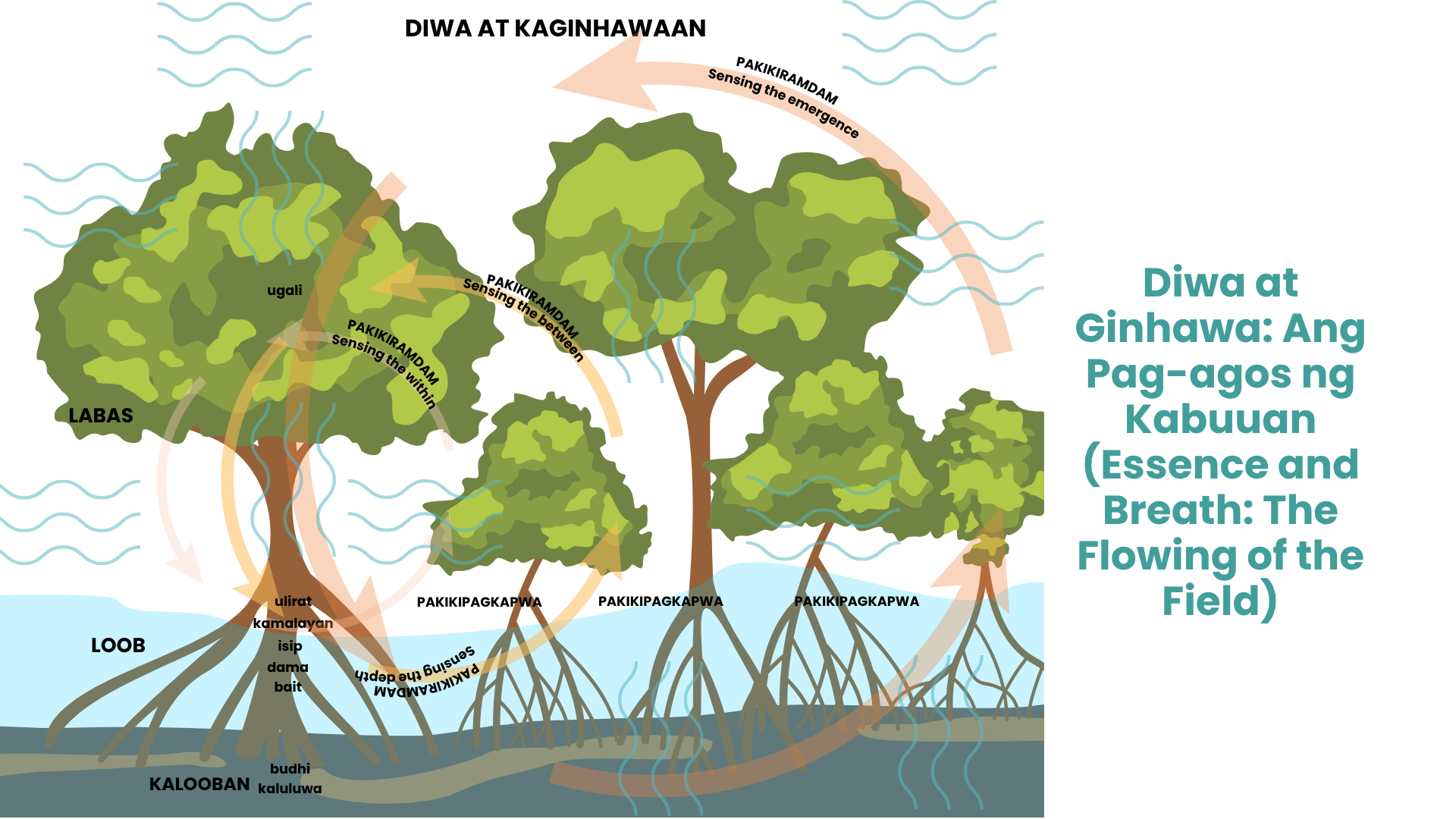
I go back to this line: Loób was never a closed system.
I think of loób as a mangrove. A mangrove stands in water and air at once. Its roots cross the line between what’s visible and what isn’t. This is close to how loob actually works. Loób only becomes knowable through what Salazar called its galaw, its movement. It shows itself in labas, the visible self, even though most of what it is stays submerged.
Labas is what’s seen as behavior, the outward shape a person takes. But what’s seen there is only ugali made visible. Ugali is a person’s habitual way of being. It forms under the surface, in loób, before it ever breaks into the open air as the person others come to know.
Loób itself is what stands submerged, where no one else can see it directly. This is the seat of five things. Ulirat is our awareness of one’s immediate surroundings. Kamalayan is consciousness, both emotional and mental. Isip is formed thought and understanding. Dama is feeling in its raw, unrefined form. Bait is the moral discernment that feeling ripens into, our common sense.
Deeper still, where the roots reach their furthest point into the mud, is kaloóban. This is loob’s most integrated state. Two things are held together here, not apart: kaluluwa and budhi.
Kaluluwa is relational soul. It isn’t sealed within one body. It’s formed and carried through relationships: parent to child, ancestors to descendant, one loób reaching into another. Budhi is moral conscience, a guide to our actions and seat of discernment.
Pakikipagkapwa is what happens where one loób’s roots meet another’s in common understanding, in shared grounding, and in interdependence. Kapwa is what that meeting produces: seeing the self in the other. Pakikiramdam, deep attunement, is what makes the meeting possible in the first place.
Pakikiramdam moves through every depth at once. It senses the within: loób, the self. It senses the between: kapwa, the relational field. It senses the depth: labas, loob, and kalooban together, whether in one’s own self or in kapwa, across five registers: the personal, the ancestral, the cultural, the systemic, and the ecological. Pakikiramdam is also the practice of sensing the emergence: what is beginning to unfold in the larger field, kabuuan.
Diwa is the essence that moves through all of this, through the loób, through kapwa, and through kabuuan itself. It isn’t a layer to arrive at. It’s the current running through every layer at once.
This is worth being precise about, because diwa carries more than one meaning depending on which scholar is speaking. In Virgilio Enriquez’s original taxonomy, diwa meant something narrower - habits and behavior, one item in a longer list. But later in his own work, Enriquez redefined the entire field of Sikolohiyang Pilipino as the study of diwa itself, meaning essence, the wealth of everything a person is, not one habit among many. Diwa also carries this weight in ordinary Filipino speech. Diwa ng bayan means the essence/spirit of a nation. The word was never only personal. It was always built to hold something larger than one person’s pattern of behavior.
I’m using diwa in that fuller sense. Not what a person habitually does, but what moves through them regardless of what they do through their own loób, through what they build with another in kapwa, and through the whole field they’re part of in kabuuan. It seeps into the personal, ancestral, cultural, systemic, ecological, all at once, because diwa was never confined to one register to begin with.
The field, as a living relational system, moves toward ginhawa, the ease and fullness of breath that carries diwa onward. Ginhawa isn’t the essence itself. It’s what allows the essence to move freely instead of getting stuck. Filipino Psychologist, Leonardo Mercado called it synonymous with life. He wrote plainly: “Ginhawa is synonymous with life itself. When the ginhawa is cut, so is life.” He describes it as body-mind-spirit integration.
Leny Mendoza Strobel has done more than anyone to carry ginhawa into the present moment. Writing with UP psychology professors Violeta Bautista and Elizabeth Marcelino, and through her work with the Center for Babaylan Studies, Strobel articulates ginhawa as wholeness and wellness, not a private, individual achievement, but something inseparable from culture, community, land, and spirit.
Her own words on this are worth holding:
“Our sense of wholeness, kabuuan ng pagkatao, depends on the condition of the breath, hininga... and is embedded within the context of culture and community and the absence or presence of social support systems.”
Ginhawa, for Strobel, isn’t only biological or psychological. It’s spiritual, ecological, communal, all at once. She’s explicit about what this isn’t: it’s not the Western sense of self-mastery, achieved alone, disconnected from culture, community, history, nature, land, and place.
This is why Strobel frames the work of returning to ginhawa as decolonization. It is an ecology of remembering. Reclaiming ginhawa, as Strobel suggests, is inseparable from reclaiming Filipino indigenous knowledge systems and practices more broadly, the ones colonization tried to sever people from. Breathing freely was never just physiology. It was always also about whether the culture, the community, and the land around a person could hold them.
This is the register I want ginhawa to carry here too. It is not ease as a personal accomplishment; rather, the ease in which the field is capable of holding a person well.
Kaginhawaan is the flourishing of kabuuan, moved by diwa, carried by ginhawa. It is not an end state, not something arrived at once and then that’s it. It is a living current, breathing through everything this piece has tried to hold - labas, loob, kalooban, kapwa, kabuuan.
Why choose the mangrove?
I didn’t choose the mangrove only for its roots crossing the waterline. I chose it because of what it survives, and what it makes possible.
Mangroves grow in some of the harshest conditions any plant tolerates: high salinity, low-oxygen waterlogged soil, daily tidal flooding, severe heat and sun. Most plants would die in this. Mangroves acquired specific adaptations instead: roots that breathe where the soil itself can’t hold oxygen, glands that filter salt out before it can poison them, bark built to survive water loss. Nothing about this environment is gentle. The mangrove doesn’t survive despite the harshness. It’s built specifically for it.
Out of that extremity comes density that most ecosystems can’t match. A mangrove’s tangled root system isn’t just structural; it’s also a nursery. Fish, crabs, and countless other species are born and sheltered inside those roots before the wider ocean gets them. Few ecosystems on Earth hold this much life packed into this much difficulty.
Even how mangroves reproduce reflects the relationality, adaptability, and resilience. Their seedlings, called propagules, begin germinating while still attached to the parent tree. As they are already growing, they are already rooted in relationship, before they ever drift off to find their own ground.
This is why the mangrove, not the iceberg as I initially thought, seems more like a fitting analogy of this ecosystem of relationships. Loób was never meant to survive gentle conditions by staying closed. It was built, like the mangrove, to hold extremity and density and relationship all at once and to keep growing new life directly out of that difficulty, not despite it.
And now what?
This was a deep rabbit hole that I got into, and I am glad that I did. It solidified and integrated a lot of these concepts and practices that have been circling in my head. Putting this into a specific image to show the complexity, beauty, and dynamism of the human psyche, the relational fields, and the bigger field in general is so rewarding and astonishing. I am in awe of the “laman” (content), “lawak” (breadth), and “lalim” (depth) that Fr. Albert Alejo SJ referred to when it comes to our loób. It leaves me with more questions to explore, especially on how we form our Ulirat (our awareness of one’s immediate surroundings), Kamalayan (consciousness, both emotional and mental), and Isip (thought and understanding). I am also curious to unpack “dama, bait, kaluluwa, and budhi” as parts of sensing the depth (the following part of this series) and how all of these influence and increase our diwa and ginhawa, which is part of sensing the emergence (the last piece of this series).
Pagmumuni-muni
Alin sa loob ang kumakausap sa iyo ngayon? (Which part of loob is speaking to you right now?)
Labas: where behavior shows
What is your labas showing others right now, and does it match what’s actually true beneath it?
Where have you caught yourself performing ugali rather than living it, repeating a pattern out of habit rather than choice?
If someone could only see your labas, what would they miss entirely about you?
Loób: where you sense and feel
What has your ulirat been quietly noticing that you haven’t yet let yourself consciously register?
Where is dama, raw feeling, still waiting for bait to ripen it into focus?
What has your body already understood that your isip is still working hard to explain?
Kaloóban: where soul and conscience are held
What is your budhi asking you to reconcile? Where does it sense a gap between what you’re doing and what you know to be true?
Whose loób is your kaluluwa still carrying, a parent’s, an ancestor’s, someone whose history moves through you even now?
What would it mean to trust your own kaloóban as already whole, rather than something still being earned?
Kapwa: where one loób meets another
Whose roots are already tangled with yours, whether you’ve named it as kapwa or not?
Where in a relationship right now are you still relating from separateness, rather than from “I am no different from my kapwa”?
What has someone’s kagandahang-loób given you that you haven’t yet found a way to honor or carry forward?
Kabuuan, diwa, at ginhawa: the field, the essence, the breath
What is beginning to grow at a meeting point in your life right now, something you’re not building alone?
Where is your diwa moving freely, and where does it feel stuck, waiting for more ginhawa to carry it?
What would bahala na, not resignation, but determination in the presence of uncertainty, ask of you today?
Dear reader,
Thank you for sitting with the complexity and depth of our loob. This was never meant to be simple, and I hope it didn’t read as simple - loob holds too much life to be flattened into a single definition.
Leny Mendoza Strobel wrote something I want to leave you with, because it says what I’ve been circling this whole piece more plainly than I ever could: “The seed of our wholeness is alive in our Loob, in our pakikipagkapwa, in our sense of Dangal (dignity) and Paninindigan (conviction).”
The seed was never lost. It was only waiting to be tended, remembered, and re-membered.
Hiraya manawari,
Lana
Source:
Here’s a resource list, organized by the roles these works actually played in building the piece. It is not alphabetically arranged, so it doubles as a reading path if you want to go deeper yourself.
Foundational sources — loob, labas, lalim, kalooban
Covar, Prospero R. Kaalamang Bayang Dalumat ng Pagkataong Pilipino [Folkloric Understanding of Filipino Personhood]. 1992.
- The banga (clay jar) metaphor; labas, loob, and lalim as the structural architecture of Filipino personhood; kaluluwa and budhi held together at lalim.Alejo, Albert, SJ. Tao Po! Tuloy! Quezon City: Office of Research and Publications, Ateneo de Manila University, 1990.
- The foundational text on loob as relational interiority.Alejo, Albert, SJ, and Julia Riddle. “Loob as Relational Interiority.” Social Transformations, 2018.
- The abot-malay, abot-dama, abot-kaya structure; laman, lalim, at lawak.Alejo, Albert, SJ. “Loob ng Tao.” Social Transformations, 2018.
- A more accessible, recent meditation on loob’s meaning.Miranda, Dionisio M. Loob: The Filipino Within. 1989.
- The three inner dyads: malay at isip, dama at bait, ugali at kalooban.
Sikolohiyang Pilipino and its founding vocabulary
Enriquez, Virgilio G. From Colonial to Liberation Psychology. 1992.
- The six-part taxonomy of loob’s subject matter (kamalayan, ulirat, isip, diwa, kalooban, kaluluwa); the value framework centering kapwa and pakikiramdam; kagandahang-loob as the ground of moral life.Pe-Pua, Rogelia, and Elizabeth Protacio-Marcelino. “Sikolohiyang Pilipino: A Legacy of Virgilio G. Enriquez.” Asian Journal of Social Psychology, 2000.
- The clearest overview of the whole Sikolohiyang Pilipino system.
Loob across languages and disciplines
Mercado, Leonardo N. The Filipino Mind: Philippine Philosophical Studies II. Washington, D.C.: The Council for Research in Values and Philosophy, 1994.
- Loob’s four classifications (intellectual, volitional, emotional, ethical); loob mapped across buot, nakem, lub, and amanat.
Loob and history
Ileto, Reynaldo C. Pasyon and Revolution: Popular Movements in the Philippines, 1840–1910. 1979.
- Lakas ng loob traced through the Philippine revolution and the vocabulary of the Pasyon.
Loob and virtue ethics
Reyes, Jeremiah. “Loób and Kapwa: An Introduction to a Filipino Virtue Ethics.” Asian Philosophy 25, no. 2 (2015): 148–171.
- Loob as relational will; the pillars of loob and kapwa supporting a distinct Filipino virtue tradition.
Loob and lalim’s dialectic with labas
Salazar, Zeus A. The loob-labas dialectic and galaw as the movement through which loob becomes knowable. Source uncertain — likely drawn from personal instruction rather than a specific publication; see note below.
- The loob-labas dialectic; galaw as the movement through which loob becomes knowable.
Ginhawa
Mercado, Leonardo N. “Soul and Spirit in Filipino Thought.” Philippine Studies 39, no. 3 (1991): 287–302.
- Ginhawa’s embodied seat in the intestinal region and liver.Strobel, Leny Mendoza, with Violeta Bautista and Elizabeth Marcelino. “GINHAWA/BREATH: Wholeness and Wellness in the Filipino and Filipino American Experience.” Medium, October 11, 2021.
- Ginhawa as culturally embedded wholeness, not individual achievement; sigla, gaan, gana, ligaya named as its felt dimensions.Strobel, Leny Mendoza. “Towards an Ecology of Remembering: Decolonizing the Body, Memory, and Desire.” Keynote address, Bantula Conference, National Commission on Culture and the Arts, October 21, 2022. Published on Medium, October 30, 2022.
- Ginhawa tied directly to kabuuan ng pagkatao; “the seed of our wholeness is alive in our Loob.”Bautista, Violeta Villaroman. “Gaan at Gana sa Buhay: Sikolohiya ng Sarap, Ligaya at Ginhawa sa Pananaw ng Sikolohiyang Pangklinika” [Lightness and Vitality in Life: The Psychology of Pleasure, Joy, and Ginhawa from a Clinical Psychology Perspective]. In J. A. R. Cantiller and J. A. Yacat, eds., ISIP: Mga Kaisipan sa Sikolohiya, Kultura at Lipunang Pilipino, Tomo 1, 15–44. Pambansang Samahan ng Sikolohiyang Pilipino, 2011.
- The four felt markers of ginhawa: sigla, gaan, gana, ligaya.
Wow, Lana. This is so intensely rich. It's something I'll have to come back to over time to really digest.
For now, what's really standing out to me, having done a lot of work in New Zealand and Hawaii, are the deep connections with some key cultural concepts and ways of being that seem consistent across the Austronesian diaspora, and yet are expressed in richly varied ways (like whanaungatanga, utu, and wairua in Māori).
And then you get very different but equally rich cultural landscapes in places like the Basque Country, with a deep tradition of egalitarianism, direct democracy, autonomy, etc. (In a language where, for example, the root for words like "tool", "ax", and "hammer" is the word for "stone," showing just how far back the language goes, even in its modern form.)
So I've been thinking a lot the last few years about how the future of social change and system-change is actually to be found in the past, in our roots.
Tokona Te Raki, the Māori futures collective in New Zealand, has developed Te Korekoreka, a distinctly Māori future-making framework (https://www.tekorekoreka.co.nz/).
Melanie Goodchild and the Anishnaabeg teachers she works with are integrating modern systems thinking with traditional Anishinaabe ways of making meaning and relating among ourselves, and with others, and with the earth.
In the Basque Country, the team at Aranzatzuab is leading the way toward more generative and participatory forms of governance, drawing on the deep democratic, humanistic, and cooperative traditions of the Basque people.
I'm seeing more of these culturally grounded approaches emerging around the world, and I'm super curious what a distinctly Filipino approach to system change might look like based on what you're sharing here, or if one already exists.
(And now that I've written so much in one comment, I think I'll do an article exploring this trend :)