
SENSING THE FIELD BETWEEN US: The Four Dimensions of Relational Field Quality
Sensing the Between

I touched on this topic in Part Three: PAKIKIRAMDAM: A Four-Layer Sensing Practice Sensing the Between . My suggestion is to read Part One — The Four Layers: An Introduction which offers the orienting map. Part Two — Sensing from Within explored the body as the first site of knowing. Each part can be read on its own, but they deepen in sequence.
As a highly sensitive person, I can easily gauge the energy of the space. This ability was something I noticed very early on in life. I have been in rooms that felt warm before anyone had spoken. I have been in rooms that felt cold despite the smiles. I have been in rooms where the air felt thin, where everyone was present yet no one was really there.
And I have been in rooms where something opened. Where the field between people held more than expected. Where what was real could simply be, and be held without translation, without management, without the exhausting labor of making oneself acceptable.
These are not impressions of a space. They are sensings. They are attunement to the field that the body registers. It is the quality of a relational field before the mind has formed an opinion about it. This can be in the way that the chest opens or contracts. How the breath deepens or shallows. When the jaw holds or releases. Something in the nervous system is already reading the room, already assessing: can I be here as I am?
This is pakikiramdam, the shared inner perception, the Filipino practice of deep sensing and attunement that is applied not only to the interior (sensing the within) but to the between-space. This is sensing the living field that exists in the space between people.
But what exactly are we sensing?
For some time now I have been holding an inquiry: if we are going to become more fluent in sensing relational fields, we need a vocabulary for what we are actually reading. Not just tight or open, safe or unsafe, but a richer, more precise language for the qualities of the field that our bodies are already registering. We need to articulate with better nuance and gradience what it is that we are sensing.
As I contemplate on my own practices, I realised that what might seem quick and accessible for me given my differently wired brain and my unique “iceberg” (with my own ancestral and cultural histories and lived experiences) might not be as easy or understandable for others. This is why I want to offer four dimensions of sensing that can support us in understanding what is alive or depleted in the space between us.
Temperature. Texture. Weight. Density.
These are dimensions of the relational field, felt simultaneously by everybody in the room, whether or not anyone acknowledges them or even names them.
WHAT IS A RELATIONAL FIELD?
Before we explore the four dimensions, let me name what I mean by the relational field shared between people. (This has got me into thinking how to also practice pakikiramdam with our more-than-human kins! Perhaps another post to write about and another rabbit hole to get into :))
The (human) relational field is the actual quality of the between-space that emerges whenever two or more people are in contact. It is shaped by the nervous systems present, the histories they carry, the active power dynamics, the cultural maps of belonging operating beneath the surface, and by everything that has happened in this relationship, this room, this collective before now. It is the “collective iceberg” forming between individuals.
The field is real. It affects what is possible. It can expand or contract what people are able to sense, say, feel, and become in a given space. It can resource or deplete. It can hold or it can crush and it can be sensed through pakikiramdam, through the body’s intelligence, and through the honest noticing of what the nervous system is already registering.
Reading a relational field well means sensing all four dimensions (Temperature, Weight, Texture, Density) and noticing how they interact with each other.
THE FIRST DIMENSION: TEMPERATURE
How warm or cold is this field?
Temperature is the most immediate dimension of relational field quality. It is registered before anything is said, in the quality of attention offered when you enter a space, in the tone of voice that greets you, or in the presence or absence of genuine interest in your arrival.
Temperature is the field’s answer to the body’s most primal question: am I welcome here as I am?
The temperature can be cold, cool, warm, or hot. Check out the graph below to further understand the felt quality, what the field is carrying and communicating, the boundary quality, and how power is experienced in the field.
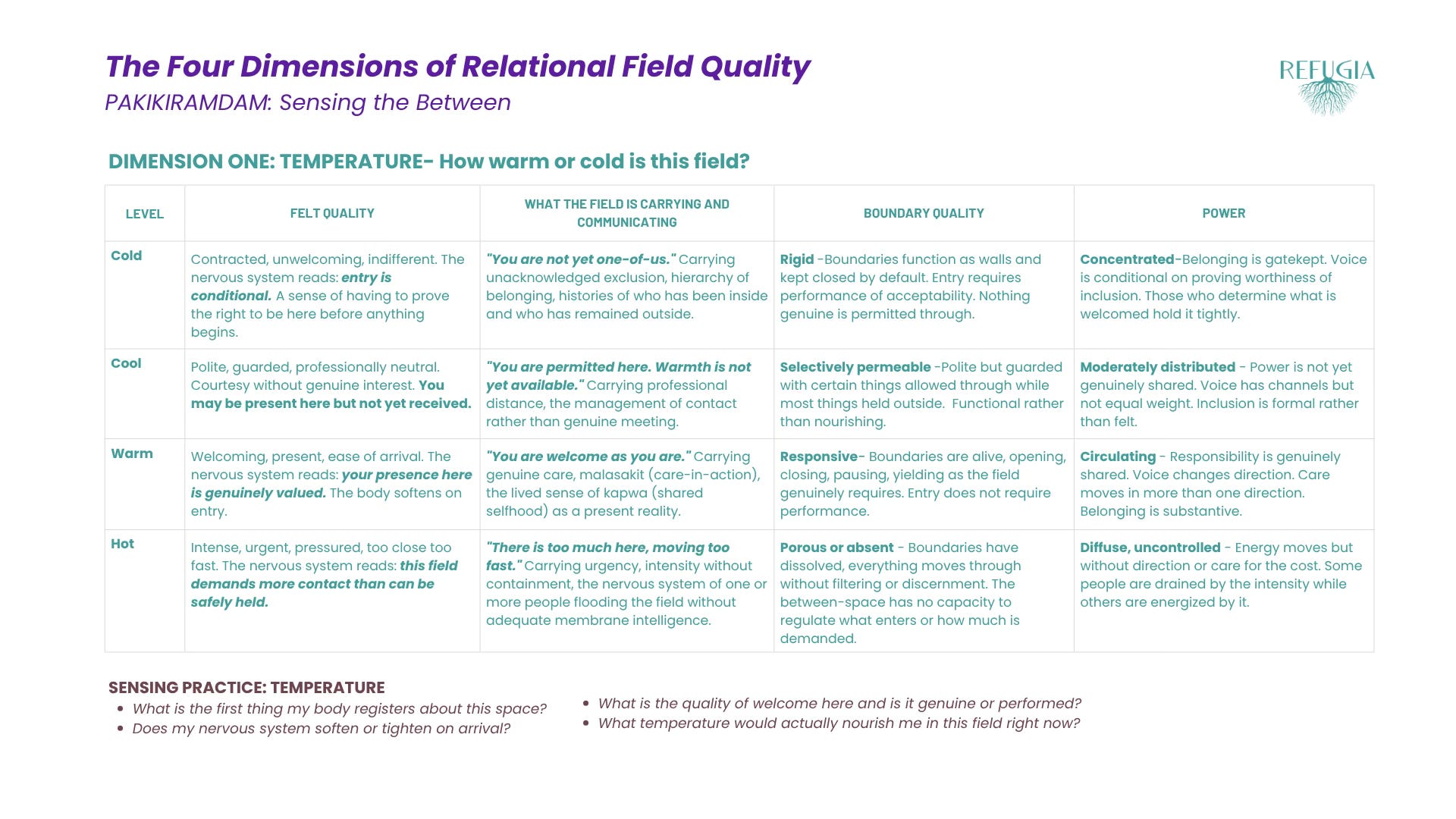
The ideal is not maximally warm. It is appropriately warm. This is the felt quality of ginhawa (ease, full breath, the spirit moving freely) in the relational space. A field whose temperature allows the nervous system to open rather than brace, without requiring it to dissolve.
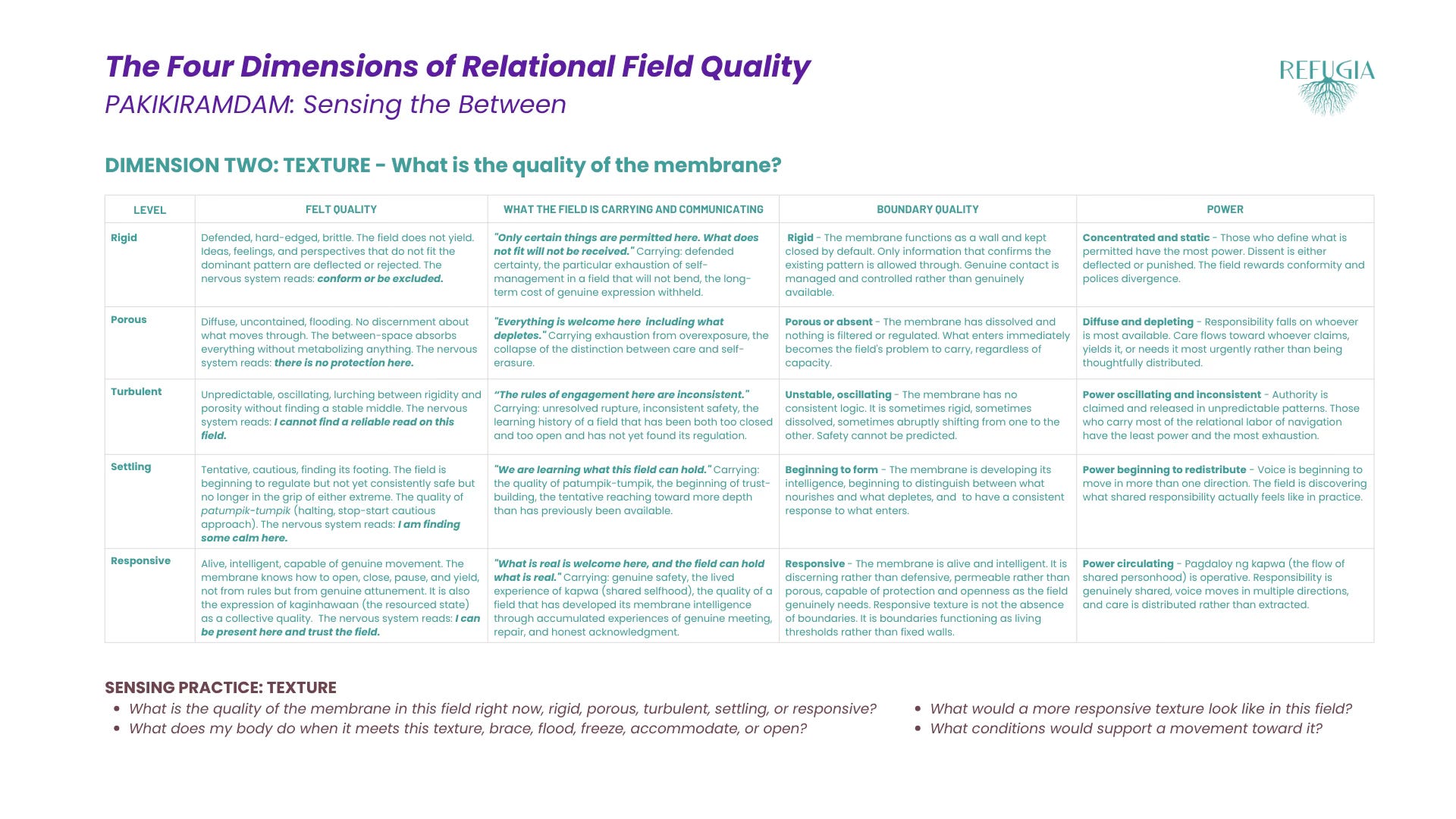
THE SECOND DIMENSION: TEXTURE
What is the quality of the membrane?
Texture is the dimension of the field that registers how the field regulates contact, how it manages what moves through it, what it lets in and what it filters, and how permeable or defended it is at its edges.
This dimension connects most directly to the boundaries and power work. In When Boundaries Heal , I described how boundary intelligence exists on a spectrum from rigid to porous to responsive. These states and the turbulence that arises between them describe the texture of the relational field as much as they describe individual boundary expression.
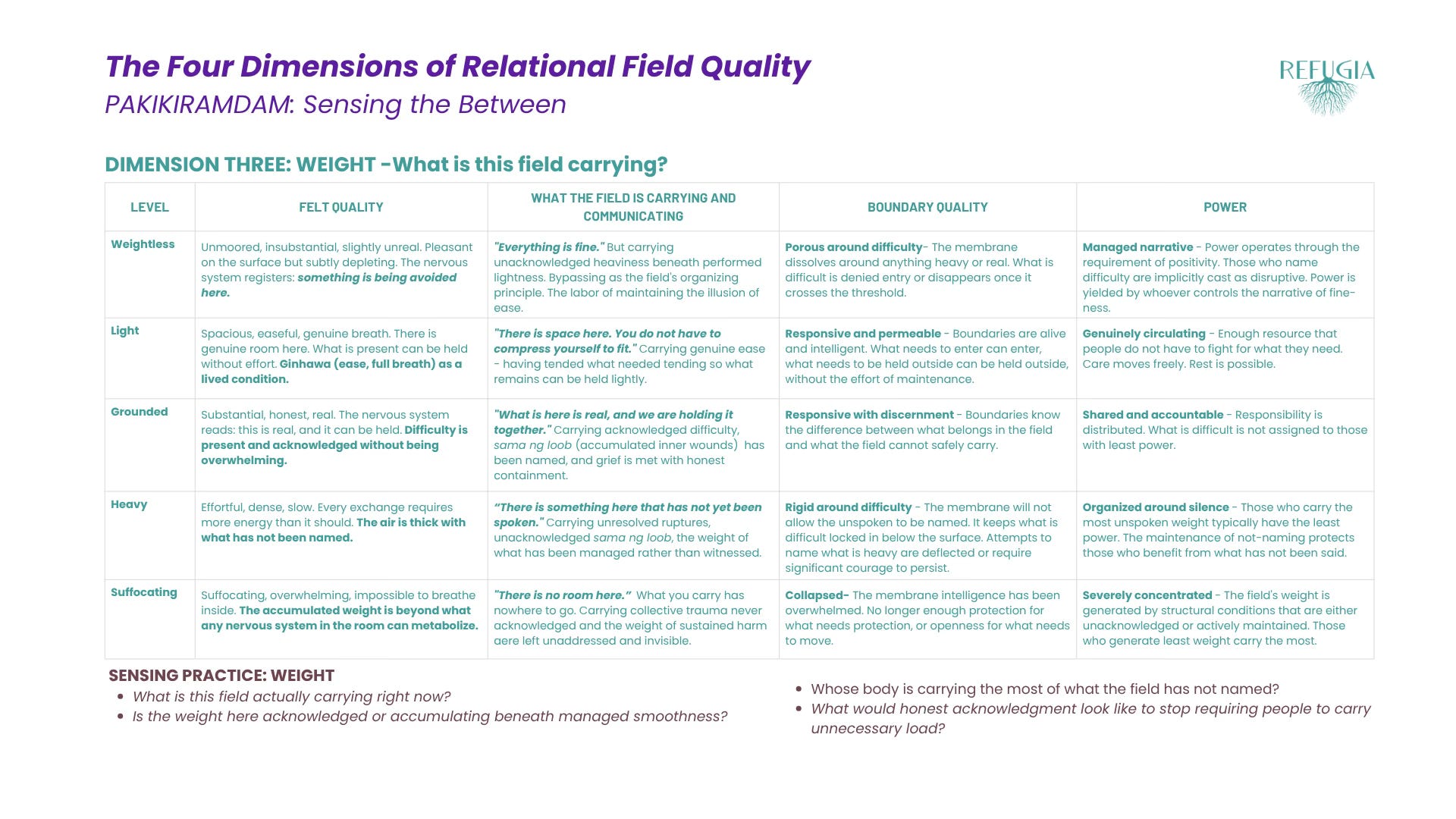
THE THIRD DIMENSION: WEIGHT
What is this field carrying?
Weight is the dimension of the field that registers what has accumulated in the between-space, what is being held, what has not been spoken, and what is present beneath the surface of the interaction.
Weight is not the same as difficulty. A field can carry difficult things with grace and feel grounded rather than crushing. The quality of weight is about whether what the field is carrying is being held consciously and honestly or whether it is accumulating beneath the surface, unnamed and unmetabolized.
Weight can be weightless, light, grounded, heavy, or suffocating. Weightless is a distinct and important category. This is the field that performs lightness while actually avoiding what needs to be held. It can feel like relief but functions as a form of collective dissociation.
THE FOURTH DIMENSION: DENSITY
How much of our shared humanity can this field hold?
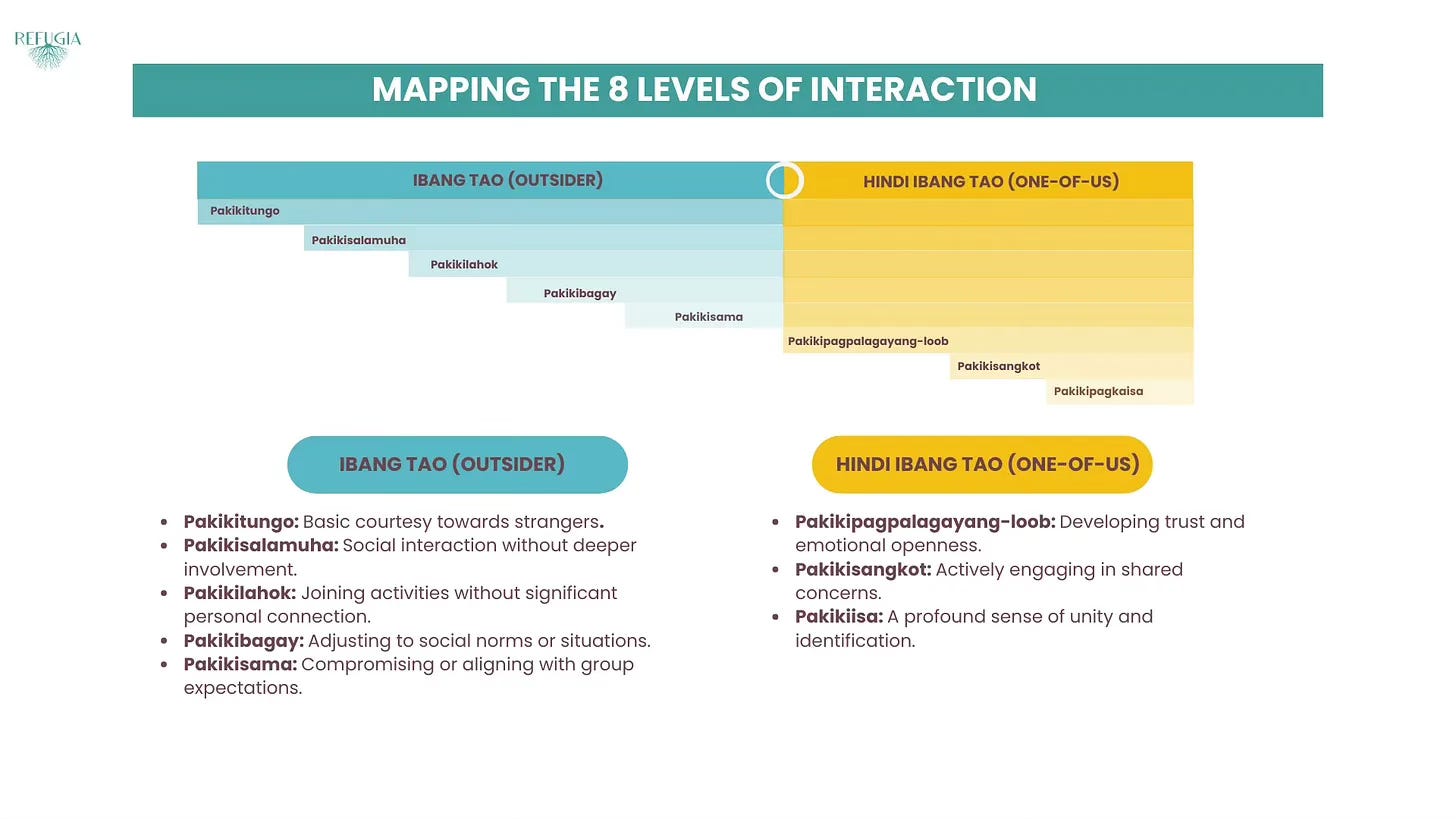
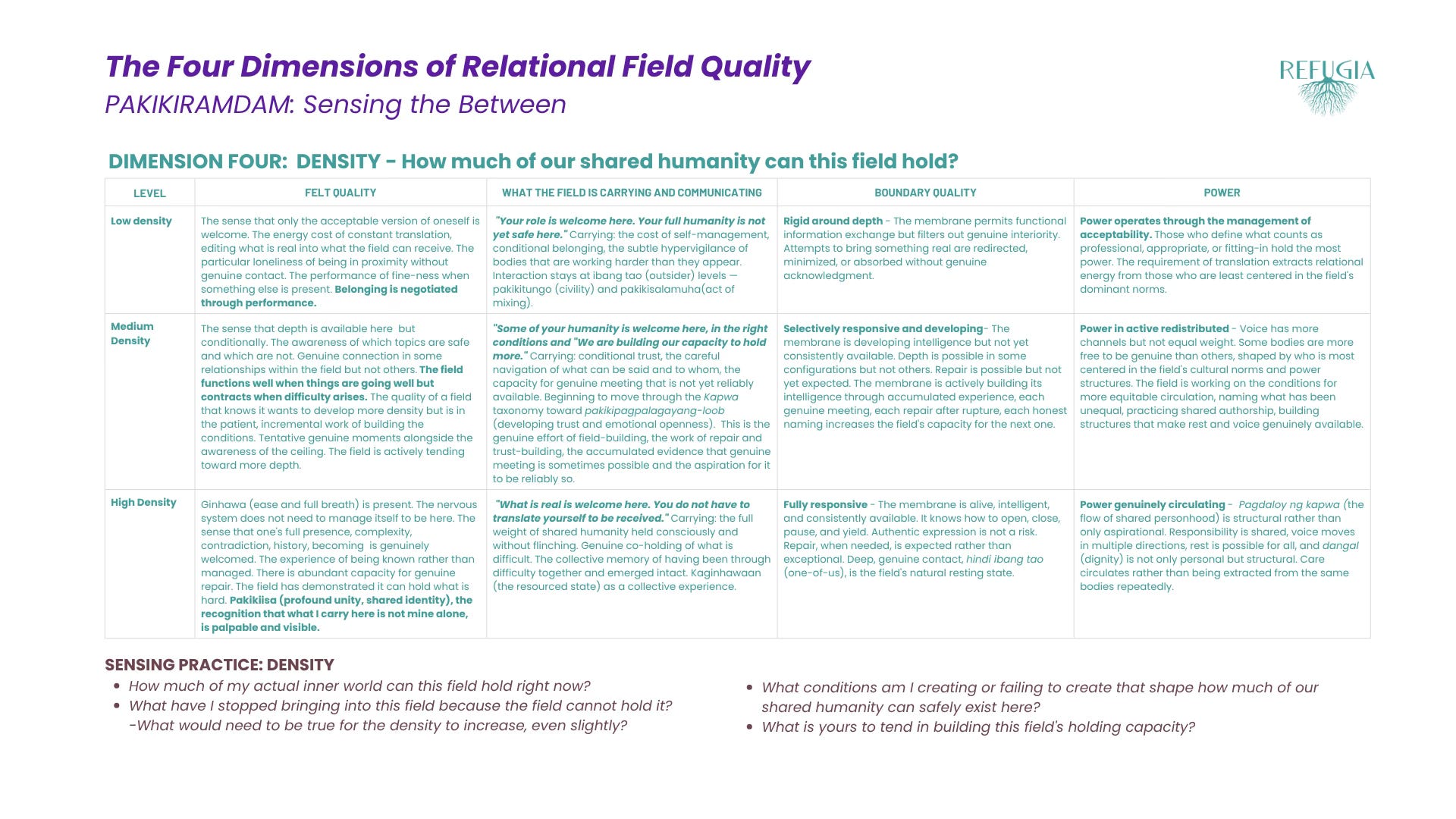
In the Relational Density of Belonging , I described density in terms of the Kapwa taxonomy, how far toward hindi ibang tao (one-of-us) a field has moved. Here I want to extend this into a fuller sensing framework including what each density level is carrying, and what its boundary and power qualities reveal.
What Density Actually Names
When I sense the between, the quality of the space in a room, a meeting, a relationship, a community, I am sensing across four dimensions simultaneously:
Temperature - how warm or cold the field is. Whether the nervous system reads the space as welcoming or hostile, nourishing or indifferent.
Texture - the quality of the membrane. Rigid and defended, porous and dissolved, or responsive and alive moving between protection and openness as the field requires.
Weight - how much the field is carrying. The lightness of genuine ease, or the heaviness of what has not been said, witnessed, or tended.
And then there is the fourth dimension. The one that is hardest to name and perhaps most important to understand.
Density — the capacity of the field to hold the full weight of our shared humanity. How much complexity, contradiction, grief, becoming, and aliveness can exist in this space without being compressed, managed, bypassed, or required to make itself smaller before it is received.
Density is not a measure of emotional intensity. A field can be very emotionally intense and have very low density - when the intensity cannot be held, when it floods without containment, and when the nervous systems present have no capacity to metabolize what is arising. A field can appear quiet and still while holding enormous density - when what is present is genuinely met, and when complexity does not have to be simplified in order to be welcomed.
Density is not the same as temperature, a field can be warm and have low density. It is not the same as weight, a field can be heavy and have high density. And it is not the same as texture, a field can be responsive and still be building its density. Density is the distinct question of how much of our actual humanity the field can metabolize without flinching, filtering, or requiring it to be made smaller before it is received.
Density is the deepest dimension of relational field quality and the one that most directly reflects the field’s capacity for genuine meeting, genuine belonging, and genuine healing. Relational density is the field’s capacity to be in kapwa (our shared humanity).
The Biology of Density
Density is not only a psychological or social phenomenon. It has a biological substrate.
When nervous systems co-regulate, when attunement stabilizes the space and responsiveness replaces reactivity, interiority becomes shareable because people are not just more open, they are also confident that the field can regeneratively hold what is emerging.
What this means, at the cellular level, is that density requires regulated nervous systems as its foundation. A field cannot hold more complexity than the collective nervous system regulation of the people within it can support. This is why a room full of dysregulated bodies, however well-intentioned, however skillfully facilitated, has a low ceiling for what can be genuinely held and why a room with even two or three deeply settled bodies can create conditions for extraordinary depth.
Chronic stress biases the body toward short-horizon energy use, mobilizing resources for immediate survival while reducing investment in long-term maintenance and repair. In relational fields, this biological reality scales. A chronically stressed collective has low density capacity, not because of individual failings but because the nervous systems present are organized around immediate threat management rather than the metabolizing of complexity. They are doing what biology requires of them under those conditions. They simply cannot hold what a resourced system can hold.
This is why the Refugia practice of settled bodies settle bodies is not a platitude. It is a density claim. A settled body in a field increases the field’s collective capacity to hold what is genuinely present. One person’s nervous system regulation ripples outward into the field’s metabolizing capacity.
Three Levels of Density
Sensing density in a relational field means sensing which of these three conditions is currently operative.
Low Density - The Field Can Hold Roles, Not People
In a low-density field, the interaction has a ceiling. Information can be exchanged. Tasks can be coordinated. Pleasantries can be offered. But the inner world, the actual experience of being a complex, historically formed, sometimes contradictory human being in this moment, must stay behind the membrane.
What low density feels like from within:
The sense that only the acceptable version of oneself is welcome
The energy cost of constant translation, of editing what is real into what the field can receive
The particular loneliness of being in proximity without genuine contact
The performance of fine-ness when something else is actually present
The sense that bringing what is real would be too much, too strange, too slow, too politically risky, too disruptive to the image of functionality the field needs to maintain
In low-density relational fields, interaction stays at the level of roles, functions, and scripts. We exchange information, coordinate tasks, and perform fitting-in, but our inner landscapes remain private, protected, or invisible.
Low density is not inherently a failure. It is appropriate in many contexts like a first meeting with a stranger, a professional interaction that does not yet have enough history to hold depth, or a relational field still finding its footing. The problem is when low density becomes the permanent ceiling, when the field can never develop the capacity to hold more than performance, no matter how much time passes or how much trust is nominally established.
Low density maintained over time has costs. Belonging is negotiated through performance. Trust is conditional, and conformity becomes currency for engaging. Politeness replaces presence, yet beneath this smoothness lives a quiet contraction, a hypervigilance to bracing and tension. The bodies in that field are working harder than they appear to be.
Medium Density - The Field Can Hold Some Truth, in the Right Conditions
Medium density is the field of conditional depth. Here, genuine contact is possible but it requires the right conditions to activate. The right people in the right configuration. The right container. The right level of trust having been established. The right moment.
What medium density feels like from within:
The sense that depth is available here but it has to be earned or carefully navigated
The awareness of which topics are safe and which are not
The experience of genuine connection in some relationships within the field but not others
The field functioning well when everything is going well but contracting when difficulty arises
The feeling that repair is possible but not yet automatic, not yet woven into the fabric of the field as an expectation
This is the settling territory, the field that is building its capacity, that is not yet at the ceiling of low density but has not yet reached the consistent holding of high density. Most of the fields we inhabit in organizational and communal life live at medium density. They are capable of more than they are currently organized to provide. They are genuinely worth tending.
High Density - The Field Can Hold the Full Weight of Our Shared Humanity
In a high-density field, something qualitatively different is possible.
Our experiences do not have to be translated into acceptable forms before they are received. Our contradictions can coexist. Our grief and our joy can appear in the same room. Meaning is not carried alone; it is co-held.
High density does not mean the field has no boundaries or no structure. It does not mean everything is always shared with everyone. It means that when something real needs to be present, when the complexity of being genuinely human in this moment needs to enter the space, the field has the regulatory and relational capacity to receive it without collapsing, panicking, managing it away, or requiring it to be smaller before it is welcome.
What high density feels like from within:
Ginhawa (ease and full breath) - the nervous system does not need to manage itself to be here
The sense that one’s full presence - complexity, contradiction, history, becoming is genuinely welcomed
The experience of being known rather than managed
The capacity for genuine repair when rupture occurs - not because it is required but because the relationship is worth it
The particular quality of pakikiisa (profound unity, shared identity) - the recognition that what I carry here is not mine alone, and that the field can be trusted with it
Kaginhawaan as a collective experience - the resourced state not only in individual bodies but in the living field between people
High density fields are not utopias. They carry difficulty with honesty rather than bypassing it. They move through rupture rather than around it. What makes them high density is not the absence of challenge but the field’s demonstrated capacity to hold challenge without collapsing into either rigidity or dissolution.
THE FOUR DIMENSIONS TOGETHER
These four dimensions are always present simultaneously. They inform and shape each other. Reading a relational field well means sensing all four and noticing how they interact.
Some combinations:
Warm, heavy, settled texture, medium density
A community holding shared grief with genuine care and enough safety to be honest. The temperature is welcoming, the weight is real and acknowledged, the texture is finding its footing, the density is growing. This field is in genuine process. It deserves tending and patience.
Cold, heavy, rigid texture, low density
An institution carrying unacknowledged harm where warmth is absent, the weight is oppressive, the membrane is a wall, and nothing of genuine humanity moves. This is the field that depletes the people within it even when it asks for their best. Leadership here requires naming what is present before anything else can change.
Warm, weightless, porous texture, low density
A relational field that performs warmth and ease but has no membrane, no discernment, no capacity to hold difficulty. Pleasant on the surface but depleting over time. The warmth here requires constant maintenance because nothing real can land.
Cool, grounded, responsive texture, medium density
A professional field that is appropriately boundaried, honest about what it holds, and capable of genuine movement and repair. Not intimate but trustworthy. A field worth inhabiting and slowly building toward higher density.
Hot, crushing, turbulent texture, low density
A field in crisis. Intense, overloaded, oscillating between rigidity and flooding. No room to breathe, no membrane intelligence, no capacity to metabolize what is arising. Urgent but cannot regulate. This field needs to stop before it can do anything else.
Warm, light, responsive texture, high density
Kaginhawaan in the relational field. The resourced state as a collective experience. The conditions where kapwa (shared selfhood) genuinely flourishes. This is the field worth building toward as a living condition that is tended, returned to, and restored when it is disrupted.
What Shapes Density and What Depletes It
What builds density
Genuine co-attunement - the consistent presence of settled nervous systems in the field over time. Each experience of being regulated in the presence of another builds the field’s collective capacity.
Witnessed repair - when rupture is acknowledged and moved through rather than ignored or managed, the field learns that difficulty is survivable. This is perhaps the single most powerful builder of relational density. A field that has been through genuine repair and emerged intact has demonstrated to itself that it can hold what is hard.
Honest naming - when what is actually present can be named without penalty, the field’s capacity to hold complexity expands. Not because naming is always comfortable but because it trains the field in the tolerance of reality.
Pacing and tending - I will only go as fast as the slowest part of us feels safe to go. Density cannot be rushed. Fields build their holding capacity incrementally, through accumulated experiences of being met at whatever level of depth is genuinely available — and finding that the field does not require more than that.
Cultural and ancestral grounding - fields rooted in cultural wisdom that honors the full humanity of the people within them develop density more naturally. When the cultural ground includes pakikiramdam (shared inner perception), pagdadamayan (active solidarity), and kagandahang-loob (care from shared humanity) as live practices rather than aspirational values, the conditions for density are already partially present.
What depletes density
Urgency - urgency compresses the field. When the pace of engagement is driven by productivity demands rather than genuine capacity, the nervous systems present cannot metabolize complexity. The field flattens.
Unacknowledged power differentials - when power flows in primarily one direction and that pattern is not named, the field’s capacity for honest depth is limited. Those who carry less power within the field must manage themselves more carefully, spending relational energy on navigation rather than presence.
Unrepaired rupture - when breaks in connection go unacknowledged, the field develops a kind of accumulated wariness. Each unrepaired rupture creates a small contraction in what can safely be held next time.
The performance of depth without its substance - some fields perform high density while actually operating at low density. The language of vulnerability, the appearance of openness, the gestures toward authenticity, without the genuine regulatory capacity to receive what those gestures invite. This is perhaps the most costly form of density depletion because it creates a double bind: people attempt genuine depth and find that the field cannot actually hold it, which teaches the nervous system that depth is risky in exactly the spaces that claimed to be safe.
Pakikiramdam and Density Sensing
Sensing the density of a relational field, its current capacity and its potential, is one of the most important practices available to anyone who works with, leads, or cares for groups of people.
When I sit with a group, before the agenda begins, I am already sensing density through the body, through the quality of the field as people arrive. Whether presence is genuine or performed. Whether the silence between words is comfortable or carefully managed. Whether bodies are settling into the space or bracing against it.
Here are the sensing questions I carry into relational fields:
For temperature: What is the felt quality of welcome in this space? Is my nervous system reading warmth, coolness, or something else entirely?
For weight: What is this field carrying that has not yet been named? What is the load beneath the surface of what is being spoken?
For texture: What is the quality of the membrane here — rigid, porous, turbulent, settling, or responsive? How is the field regulating contact?
For density: How much of our actual inner world can this field hold right now? What is the ceiling and what would need to be true to raise it, even slightly?
And then the synthesis question that holds all four:
What does this field need right now to move, even one degree toward kaginhawaan: the resourced collective state where shared humanity can genuinely flourish?
Sometimes the answer is: softening and warmth - the field needs one person to genuinely welcome what has been cautiously entering.
Sometimes it is: acknowledgment of weight - the field needs someone to name what everyone is carrying but no one has spoken.
Sometimes it is: a membrane - the field needs someone to introduce discernment, pacing, or protection where there has been dissolution.
Sometimes it is: flocking and repair - the field needs a rupture to be acknowledged before anything else can move.
Sometimes it is simply: a pause - the field needs to stop long enough for the nervous systems present to register that they are not in immediate danger.
These are not large interventions. They are the small, attuned acts of a leader, a facilitator, a participant who has developed the capacity to sense the field and respond to what it genuinely needs.
This is pakikiramdam as a collective practice. This is healing-centered leadership in action.
Tending Density as a Leadership Practice
Rather than asking “How do we make people belong?” the invitation is to reflect on: “What conditions allow relational depth to become the common experience in the system?”
This is the density question as a leadership practice. Not: how do I make my team more open? But: what conditions am I creating or failing to create that shape how much of our shared humanity can safely exist here?
The conditions that allow density to develop are not primarily programmatic. They are not achieved through a workshop or a team-building exercise. They are built slowly, incrementally, through thousands of small moments of genuine meeting through:
Pacing that honors the slowest part of the field
Power that circulates rather than concentrates
Repair that is practiced, not just espoused
Care that does not drain the same bodies repeatedly
The lived demonstration that when something real is brought into the space, the field does not require it to be smaller before it can be received
Relational density is not something we create alone. It is something we co-cultivate and it is cultivated precisely through the practice of pakikiramdam, the ongoing, patient, honest sensing of what is actually present in the field between us, and the willingness to tend what we find there.
A NOTE ON CAPACITY
There is something important to hold before we move into sensing practice.
We can only sense a field as clearly as our own nervous system’s current state allows.
A nervous system in rigid protecting reads the field through the lens of threat. A nervous system in porous protecting reads the field through the lens of others’ needs, often losing its own signal in the process. A nervous system in collapse cannot sense much at all.
This is why resourcing is the need beneath all needs. We cannot sense the field honestly from a depleted system. We can only tend the field from a place of enough resource to do so. And why the first practice of relational field tending is always the same: tend yourself first. A resourced loob (interior self) in relationship becomes resourced kapwa (shared humanity) and resourced kapwa is what changes systems.
Pagmumuni-muni — Deep Reflection
Take a moment before you begin. Feel the ground beneath you. Take one breath. Bring to mind a relational field you are currently part of, a relationship, a team, a community, a family.
Now sense its four dimensions:
Temperature:
What is the felt quality of welcome in this field?
Does your nervous system soften when you enter it, or does it brace?
What is the field communicating about whether you are welcome as you actually are?
Weight:
What is this field carrying that has not yet been named?
Is the weight sustainable — grounded and honest — or is it crushing, or falsely lightened through avoidance?
Whose weight is being carried, and by whom?
Texture:
What is the quality of the membrane here?
Is the field rigid, porous, turbulent, settling, or responsive?
What would a more responsive texture feel like in this field?
Density:
How much of your actual inner world can this field hold right now?
Where is the ceiling — and what does that ceiling cost the people within this field?
What would need to be true — what conditions would need to exist — for the density to increase, even slightly?
The synthesis question:
What does this field need right now to move toward kaginhawaan — collective ease, the resourced state as a shared experience?
What is yours to tend?
Dear readers,
These questions are not problems to be solved. They are the beginning of a sensing practice that deepens over time, through the patient, iterative, honest work of bringing genuine attention to the fields we inhabit and the fields we help create.
Hiraya manawari,
Lana
READ MORE:
BENEATH THE ICEBERG: A Healing-Centered Model of What Shapes Our Behaviors
HEALING-CENTERED RESPONSES WHEEL: Mapping Our Resourced Responses
AMPLIFYING THE RELATIONAL FIELD THROUGH “PAKIKIRAMDAM”
RESOURCING IN THE MIDST OF COLLAPSE: How We Stay Rooted When the World Feels Too Much
THE FIRST RUPTURES OF BELONGING: On Power, Rank, and the Rise of a Hegemonic Worldview
REIMAGINING HEALING: What would a healed ecosystem look like, sound like, feel like?
RELATIONAL DENSITY OF BELONGING: Mirroring the Depths of “Kapwa” in the Field
Mapping the Relational Ecosystem Boundaries
NAVIGATING TENSION THROUGH THE PRACTICE OF “PAKIKIRAMDAM”
WORK WITH ME
Healing-centered leadership matters now because the challenges we face cannot be met by systems that are either braced or depleted. They require cultures that can sense capacity, pace care, and restore containment so people can remain present without disappearing themselves.
If you are leading people in environments where fitting in has replaced belonging, where care feels heavy, or where responsiveness has eroded into overwhelm, this work offers another way. Together, we can cultivate healing-centered leadership practices that restore choice, dignity, and the shared capacity to grow without self-abandonment.
Message me to explore working together with your team or organization or join the upcoming community of practice on Healing-Centered Leadership.
Workplace cultures don’t unravel because people don’t care. They unravel because of what’s happening beneath the surface: in nervous systems, relationships, and the invisible dynamics shaping how people show up.
This 10-month long community of practice is an invitation into healing-centered leadership: the kind of leadership that can hold complexity with grace and compassion. You’ll learn practices to help you as a leader settle, reconnect, and make decisions from clarity instead of insecurities, threats, or patterns of disconnection.
Lana, it’s absolutely beautiful to read your work here.
I’ve been moving thru and with collective healing fields as a neurodivergent ADHD’er with a trauma history for several years now.
What you’ve done here to outline the sensing that we do inside of collective healing containers is profound work, because the translation into digestible aspects for modern people to grasp is true labor.
I’ve been grateful to read your offerings which come from such depth and ancestral knowings and sensing, and I thank you.
I am so looking forward to learning more from you in our community of the Pocket Project, during our community care call around neurodiversity.
I treasure what you offer here, and all of your writing & charts; you are helping to connect others to their own ancestral practices by helping make this more “visible” to our sensing ways in our modern day lives & modern day bodies.
May we all continue to tap into the body’s innate wisdom, its bioenergetic capabilities, and the amazing and blessed divine instrument that it is.
Thank you for sharing your precious gifts. ❤️🙏🏼🌹🌀